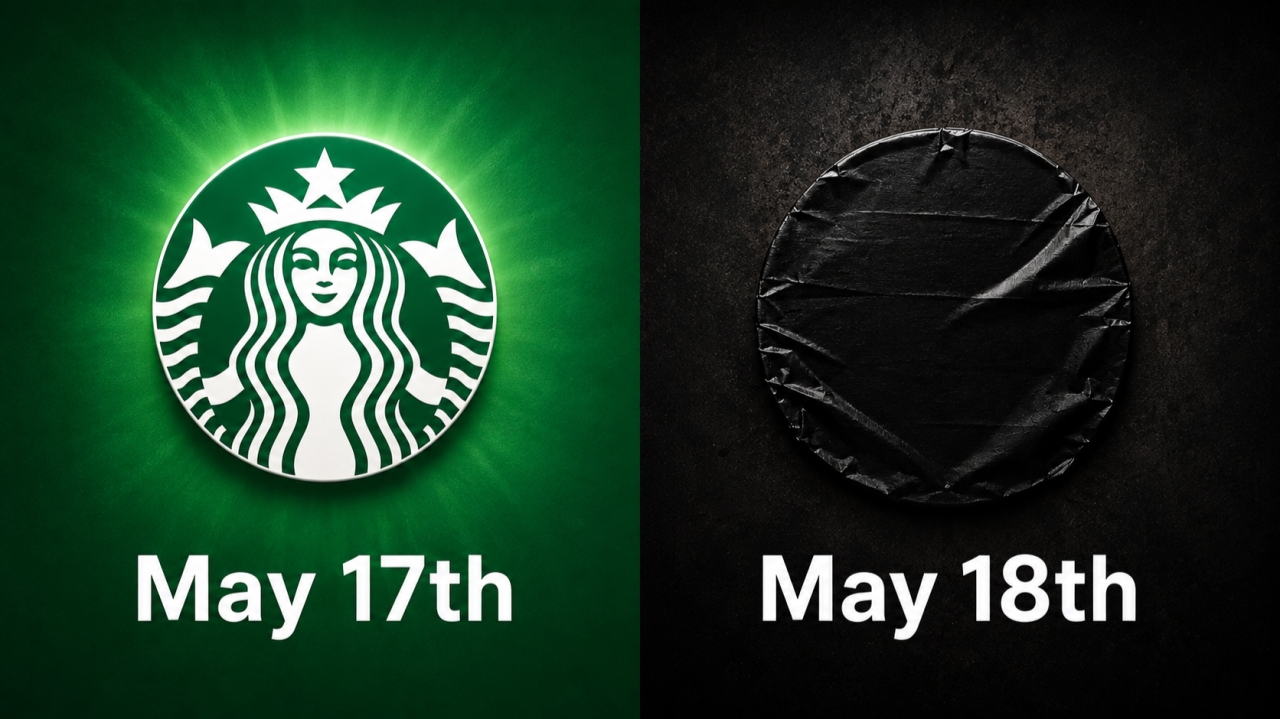
I spent over thirty years inside the corporate machineries of luxury giants like L’Oréal and Coty Inc. I have watched executive committees bypass compliance to chase vanity metrics. I have seen international campaigns crash into local walls. But what happened to Starbucks Korea in the summer of 2026 is in a class of its own.
For nearly thirty years, a green siren cup was South Korea’s ultimate lifestyle default. It was the safe choice, the universal currency of social etiquette on KakaoTalk, Korean message app.
Then came a single, unvetted marketing campaign. And the bill that arrived was measured in a $165 million quarterly loss, a $1.08 billion stock wipeout, and 15 million free coffees.
This is the complete, unfiltered autopsy of a corporate suicide.
Act I: The Unheated Wound — When a Tumbler Becomes an Insult
To understand the scale of this catastrophe, we have to look back at May 18th.
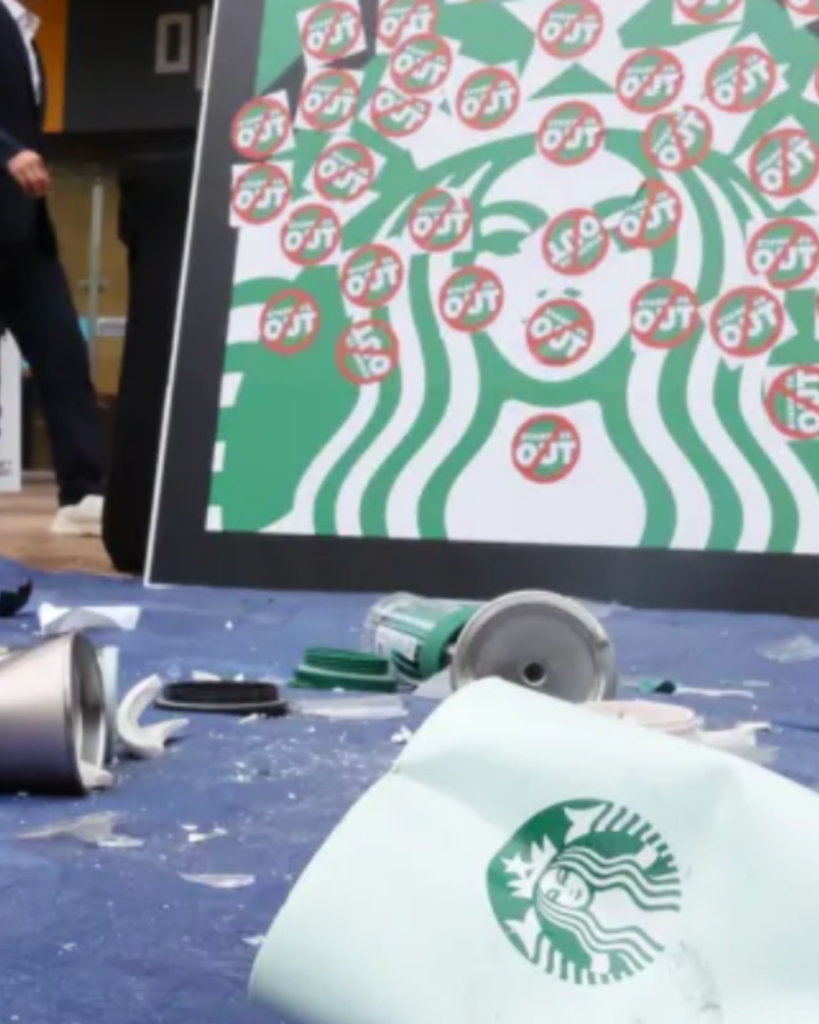
On that morning, Starbucks Korea launched what appeared to be an innocent e-commerce merchandise promotion called “Tank Day”. To an outsider or an unvetted algorithm, the name probably sounded like a bold, industrial aesthetic for high-capacity steel tumblers.
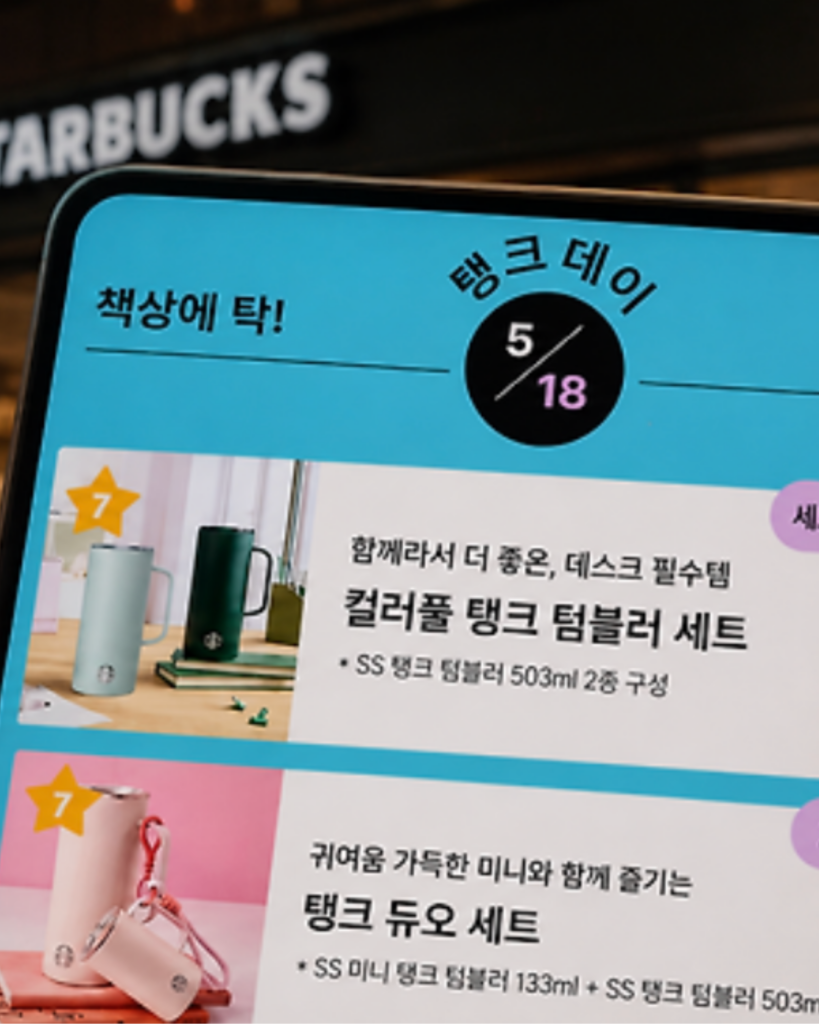
But in South Korea, May 18th is not just a calendar date. It is a historical trauma that has never fully healed.
Historical Context: May 18, 1980
The Gwangju Democratization Movement. Civilians protesting a military coup were brutally slaughtered by their own government. The dictator who ordered the massacre, General Chun Doo-hwan, sent actual military tanks to crush the uprising. His enduring, blood-soaked nickname among Koreans is "Chun Tank".
To understand the absolute horror of the phrase “hit the desk” (책상에 탁), you have to go back to January 1987.
Historical Context: A 22-year-old university student named Park Jong-chul was dragged into the Anti-Communist Investigation Bureau in Seoul. He never walked out. He was waterboarded to death by the police.

When journalists cornered the authorities about how a healthy college student suddenly died in an interrogation room, the police chief looked at the cameras and delivered a lie that burned itself into the Korean psyche. He claimed the interrogator simply slammed his hand on the table—"tak"—and the student dropped dead of sudden shock.

“탁 치니 억 하고 죽었다” (We hit the desk, and he dropped dead).

It was a cartoonish, insulting lie used to cover up a state-sponsored murder. That phrase didn't just cause outrage; it became the catalyst that ignited the June Democratic Struggle of 1987, eventually toppling the military dictatorship.
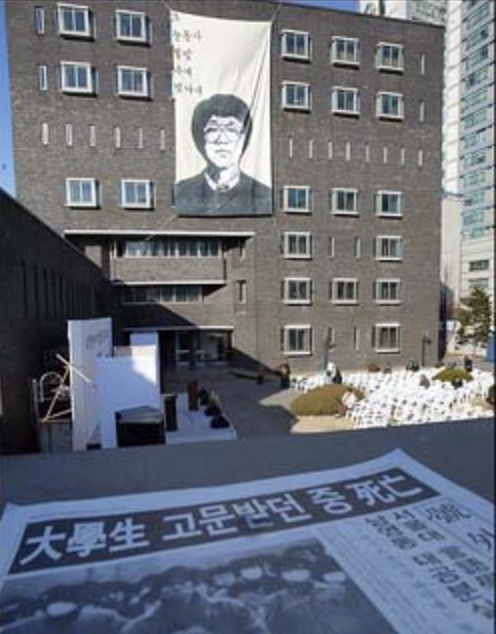
photo : Park Jong-chul, Media Today (Korean site)
Every South Korean knows exactly what those words mean. It is the anatomy of a brutal cover-up. Using “책상에 탁! hit the desk” in a marketing campaign to sell steel coffee tumblers isn’t just a lapse in judgment. It is dancing on a grave.
To any Korean, these three words carry decades of state-sponsored terror. In 1987, a student activist named Park Jong-chul was tortured to death in police custody. To cover up the murder, authorities claimed he had died of sudden shock because an interrogator simply “책상에 탁! hit the desk”.
Finally, investigators later uncovered numerical codes hidden in the background graphics of the campaign—digits widely recognized as alt-right online symbols used by toxic groups (like the local equivalent of 4Chan, Ilbe 일베 in Korean) to mock the victims of Gwangju.
The fallout didn’t just stop at a nationwide boycott. It morphed into something far more grotesque: a political proxy war.
While the rest of the country was smashing their green sirens with hammers, South Korea’s far-right trolls saw an opportunity. Members of toxic online communities—specifically Ilbe, the Korean equivalent of 4chan—began actively weaponizing the crisis. On social media, a new, sickening nickname was born: “Ilbe-bucks.”
Instead of boycotting, these extremists started posting “consumption authentication” photos—buying Starbucks en masse purely to mock the Gwangju victims and trigger the public. In Daegu, a far-right group even staged a coordinated visit to a local Starbucks, wearing matching national flag t-shirts just to order coffee and troll the nation.
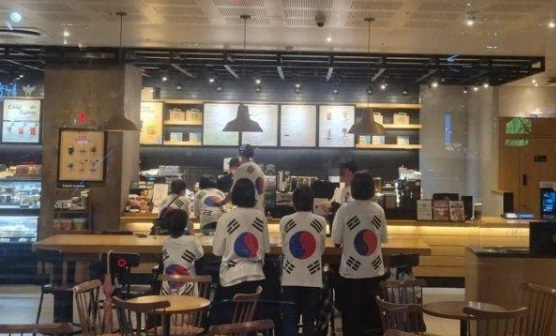
photo source : https://it.chosun.com/news/articleView.html?idxno=2023092162713
When your premium lifestyle brand is adopted as the official mascot for far-right extremists dancing on a historical grave, you haven’t just lost your market positioning. You’ve lost control of your brand entirely.
Overnight, holding a Starbucks cup went from a badge of urban sophistication to a badge of national shame.
Act II: The Anatomy of Institutional Amnesia
How does a multi-billion dollar operation fail this catastrophically?
The answer lies in the company’s internal post-mortem, which leaked to the public and revealed a complete systemic rot. This was the ultimate failure of speed over memory:
1. The Death of Human Editing
The e-commerce marketing team admitted to using generative AI to brainstorm the campaign concepts. The junior employees involved possessed absolutely zero historical literacy regarding May 18th or the dark legacy of the “hit the desk” phrase.
2. Bypassing the Guardians
To move fast and hit short-term launch targets, the marketing team bypassed the mandatory legal and compliance review entirely. The guardrails were treated as speed bumps.
3. The Rubber Stamp Chain
The campaign sailed through four distinct levels of executive sign-off: Team Leader, Department Head, Division Director, and the CEO himself. Not a single objection was raised. Several approvers signed off on the campaign without ever opening the design attachments.
This was a company so optimized for velocity that it had completely amputated its own institutional memory. When the public erupted, internal messengers showed staff reacting with genuine confusion, asking: “Why are they reacting like this?” They did not even know what they did not know.
Act III: The Hard Numbers — The Financial Reckoning
For a few weeks, corporate apologists hoped for a classic case of naembi geunseong—”pot temperament”—the Korean term for public anger that boils quickly but cools just as fast.
But you cannot buy back a nation’s memory with a PR statement. The market response was brutal, measurable, and structural.
- Operating Collapse: Korea Investment Securities projected a Q2 2026 operating loss of 229 billion KRW (roughly $165 million) for Starbucks Korea (SCK Company). A year prior, the same company posted a 403 billion KRW profit.
- Mass Exodus: Active monthly app users plummeted from 8.19 million in May to 7.06 million in June. That is a loss of 1.13 million users in just 30 days.
- Revenue Hemorrhaging: Monthly credit and debit card spending dropped from 134.3 billion KRW in April to 100.4 billion KRW in June. A massive 25% drop in transaction volume.
- Status Evaporated: On KakaoTalk’s gifting platform, Starbucks fell from its undisputed #1 rank (held for seven years) down to 9th place, overtaken by budget competitors like Mega Coffee.
| Metric | Before the Crisis | After the Crisis (July 2026) | The Bottom Line |
|---|---|---|---|
| Q2 Operating Performance | +403 billion KRW (Q2 2025) | -229 billion KRW (approx. -$165M) | A historic swing into the red. |
| Active App Users | 8.19 Million | 7.06 Million | Lost 1.13M users in 30 days. |
| Weekly Credit Card Spend | 134.3 billion KRW (April) | 100.4 billion KRW (June) | A massive 25% drop in transaction volume. |
| KakaoTalk Gifting Rank | #1 (Held for 7 years) | Dropped to #9 (Overtaken by budget brands) | Loss of default luxury gift status. |
The destruction extended straight to the parent company. E-Mart—the majority shareholder of Starbucks Korea—hit a 52-week high of 136,400 KRW in February 2026. Following the boycott, the stock plunged 41% to 80,600 KRW, erasing approximately 1.5 trillion KRW ($1.08 billion) in market capitalization.
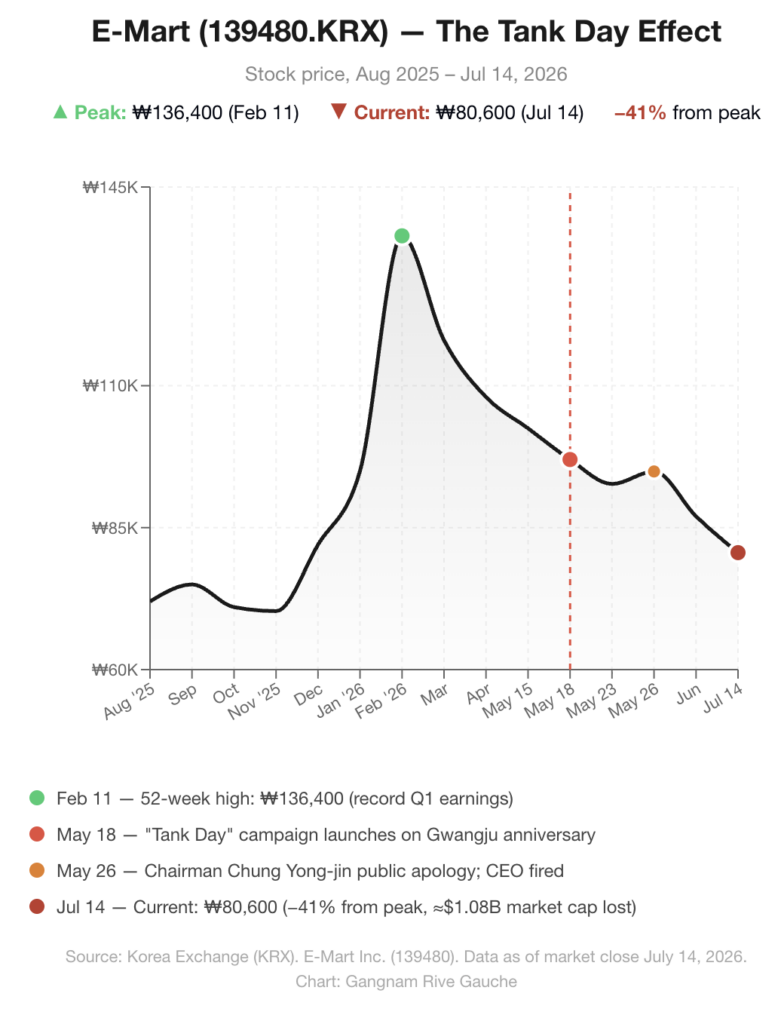
The $1.08 Billion Stock Collapse
E-Mart—the majority shareholder of Starbucks Korea—hit a 52-week high of 136,400 KRW in February 2026. By July 14, 2026, the stock had plunged 41% to 80,600 KRW, erasing approximately 1.5 trillion KRW ($1.08 billion) in market capitalization.
Act IV: Panic in Seattle and the “Guillotine” Clause
The crisis did not stop in Seoul. It reverberated all the way to Starbucks HQ in Seattle.
Deep within the franchise agreement between the local operator (E-Mart/Shinsegae) and Starbucks US lies a punitive “Call Option”. This clause dictates that if the local partner severely damages the global brand’s equity, Starbucks US has the legal right to forcibly buy back all Korean shares at a devastating 35% discount from fair market value.
This financial sword of Damocles is what triggered the corporate earthquake:
- The Purge: Former Starbucks Korea CEO Son Jeong-hyeon was abruptly dismissed alongside multiple marketing and operational leaders.
- The Humiliation: Shinsegae Group Chairman Chung Yong-jin was forced to abandon written statements, appear in person before cameras to bow deeply, and accept full personal responsibility.
- The Signature Loss: For the first time in its history, Starbucks Korea cancelled its iconic Summer e-Frequency loyalty event—their most profitable marketing engine—to avoid pouring gasoline on the smoldering boycott.
Act V: Bringing Flowers to a Funeral You Caused
In a desperate bid to win back the public, Starbucks Korea rolled out an unprecedented damage-control initiative: they distributed 15 million free drink coupons to every single Starbucks Rewards member.

That is one free latte for every three adults in South Korea.
While weekly card spending showed a minor 5.7% uptick in early July due to the massive freebie injection, the structural scar remains. The incident has entered the national lexicon. When a high school baseball team chanted “Tank Day” during a game against a school from Gwangju a few weeks ago, it proved that the brand name is now permanently entangled with historical mocking.
Giving away 15 million lattes is the corporate equivalent of bringing flowers to a funeral you caused. You might fill the room with scent, but the body is still dead.
The Hard Lesson for the Boardroom
You can hire the most data-literate marketing team in the world, optimize your SEO, and integrate the fastest AI models. But if your team is culturally illiterate in the very soil where you do business, you are operating a ticking time bomb.
Standard compliance is not a bureaucratic hurdle to bypass for the sake of quarterly speed; it is your ultimate line of defense.
Every international organization needs an independent Brand Guardian—someone who is disconnected from short-term KPIs, who is deeply fluent in the historical memory of the market, and who holds absolute, non-negotiable veto power.
Without one, you are just waiting for your own “Tank Day” bill to arrive.
What About Your Organization?
How does your company balance marketing speed with strict cultural vetting? Are your approval layers actual human filters, or are they just rubber-stamping a disaster?
Let’s talk in the comments below. 👇
I’m a Korean alien living in France—an outsider who sees both sides of the mirror. I write about the collisions between culture, marketing governance, and corporate reality.
You may be interested in this : Louis Vuitton vs Molly Tea: The $1.5 Million Flower and What It Says About Who Owns a Shape https://gangnamrivegauche.com/index.php/2026/07/15/louis-vuitton-molly-tea-lawsuit-monogram/
- Want the unfiltered analyses I cannot post on professional networks? [Subscribe to Gangnam Rive Gauche on Substack]
- Never miss a deep dive: [Follow the Gangnam Rive Gauche LinkedIn Page]