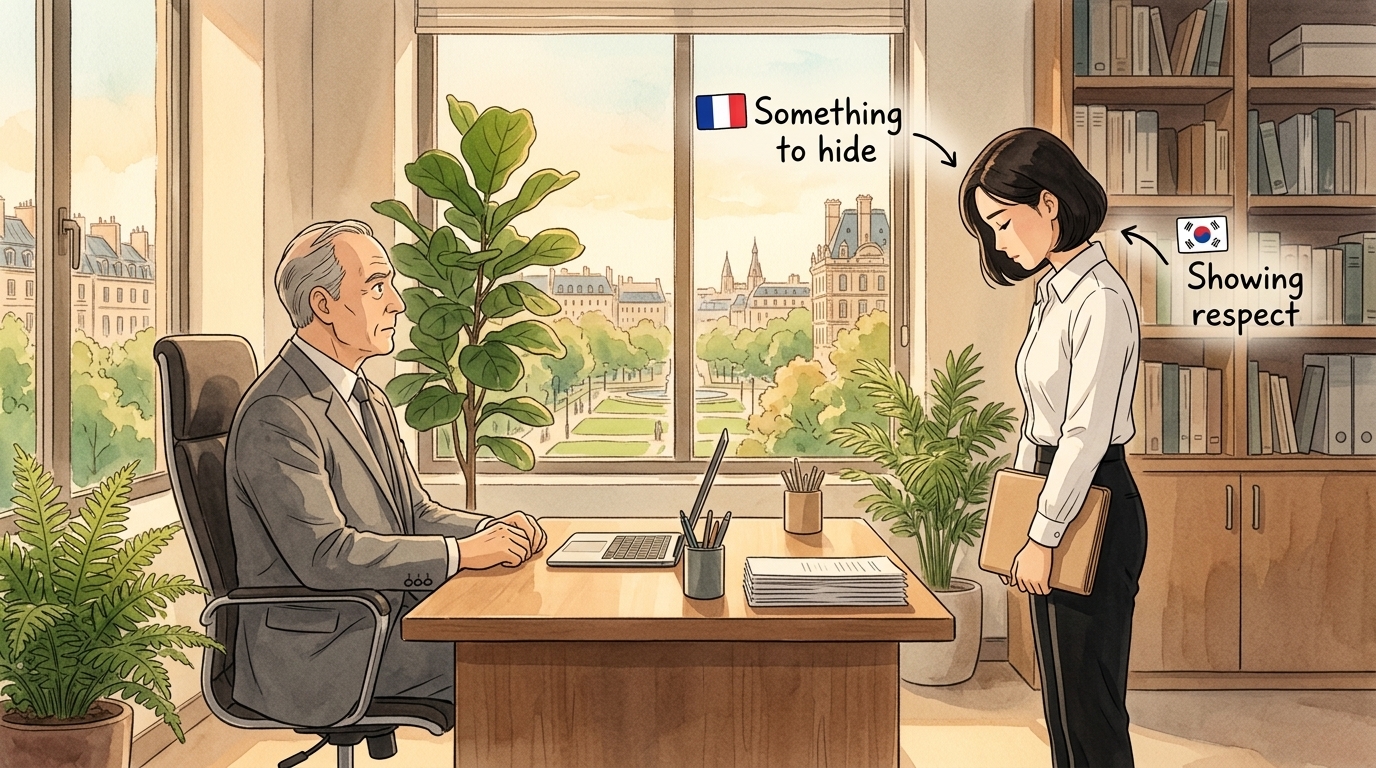
“Look me in the eye” is a demand for respect in one of my countries and pure insolence in the other.
Once you can see it, you’ll spot it in every meeting you sit in this week. You’re welcome in advance.
Picture a street in Paris. Two toddlers, roughly the same age, catch sight of the same car rolling past — and each one names it with a completely different noise. The Korean child calls out 빵빵 (ppang-ppang). The French child calls out vroum. One vehicle, one street, one afternoon, and two small people who can’t agree on what a car even sounds like. Here’s the catch: neither of them is describing a machine that still exists.
This whole train of thought started with a recent post by Andy Kondo, an analyst who covers Japan’s industrial transformation over at his newsletter UNRAVEL. His observation was tiny and flawless: Japanese toddlers call cars buu-buu, an imitation of an engine. Kondo drives an EV. It doesn’t growl. His child has never sat in anything that did. So, he asked, who is buu-buu actually for anymore?
His real subject was never cars. It was lag. Language trails technology by decades. We keep hanging old words on our machines long after the machines fall silent. An onomatopoeia, in that light, is a fossil — a small bone left over from an extinct technology, still clattering around in the mouths of children.
Kondo did this in one language. I happen to live inside three.
So I went hunting for my own fossils, across Korean, French and English. The surprise wasn’t that they’re all obsolete. It’s that each language is obsolete in its own distinct way — and one of the three, by sheer accident, quietly future-proofed itself.
The car, and the horn that outlived the engine
Start where Kondo started. Japanese children name the car after its engine: buu-buu. French children do exactly the same: vroum. English-speaking children too: vroom, brrm. Korean children break the pattern. They say 빵빵 — and 빵빵 isn’t the engine at all. It’s the horn.
That reads like a footnote. It’s the whole point.
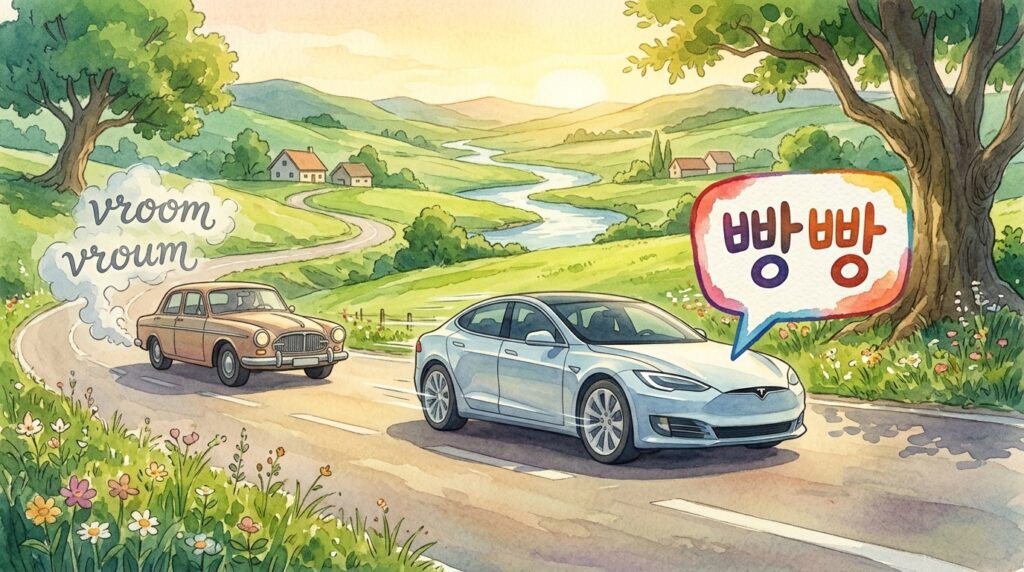
Electrify the car and the engine noise evaporates. Buu-buu dies. Vroum dies. Vroom is running on fumes. But the horn survives the switch. My own EV slips away from the kerb in total silence and still barks 빵빵 the instant someone cuts in front of me. Korean, without meaning to, named the car after the single part the future refused to delete.
Nobody planned it. A century ago Korean toddlers simply latched onto the honk instead of the growl, and that random choice aged beautifully. Japanese and French put their money on the engine. Korean put it on the horn. Only one of those bets is still standing.
Grown Koreans, for the record, still say 부릉부릉 (bureung-bureung) for an engine coughing to life. Try that on a Tesla. You can’t. 부릉부릉 is already a museum piece, and nobody has broken the news to it yet.
The telephone: a bell, a wire, a hook, a shout
Korean fossilises the sound. The old telephone went 따르릉 (ttareureung). Your smartphone has never made that noise in its life, yet Korean nursery songs still open with it.
French and English fossilise the movement instead. Neither kept the ring; both kept the hand. English speakers “hang up,” an expression that only works if there’s a hook to drape a receiver over, and there hasn’t been one in decades. They “dial” on phones with no dial. The French raccrocher and décrocher, and they composer a number as though arranging a bouquet.
Here’s my favourite pair. English hangs up to finish a call. Korean 전화를 걸다 — closer to hooking or hanging a call up — is how you begin one. Two languages reached for the same hook. One at hello, one at goodbye.
Korean holds a second, sharper fossil: 전화를 끊다, to cut the call. 끊다 means to sever, to snap something in two. It only makes sense with a physical wire feeding a phone bolted to the wall — a wire you could actually take scissors to. There is no wire. Nothing to sever. You “cut” a call that drifts through the air.
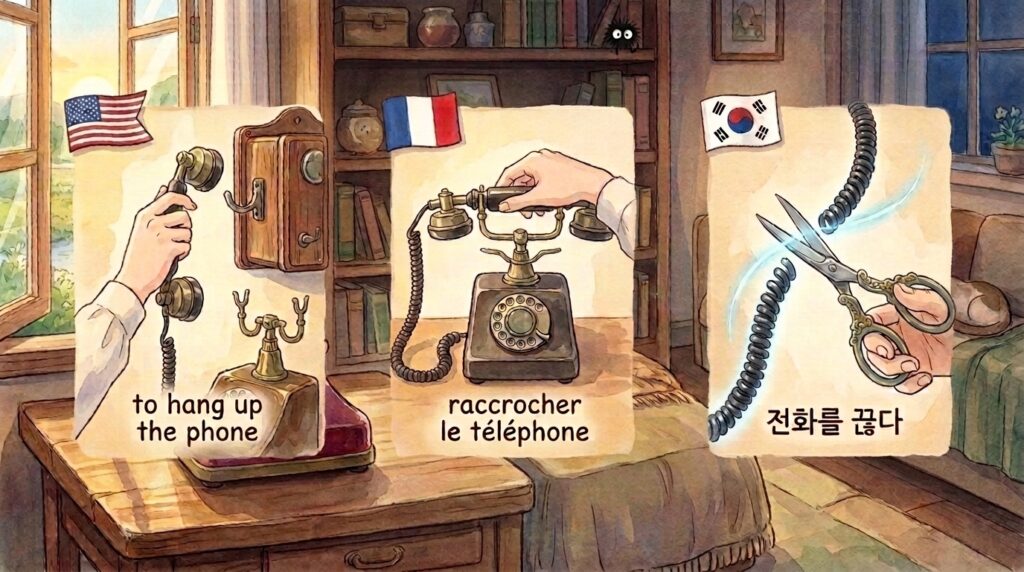
What do French and English grab for here? Not even a word — a noise. Bip. The flat tone of a dead line, the busy signal of the analogue era. Except your phone doesn’t beep at the end of a call anymore either. So Korean keeps slicing a cord that was ripped out of the wall years ago, while the West keeps listening for a beep that stopped beeping.
Lay all four side by side, and each one clutches a different piece of the corpse:
| Korean | English (UK) | English (US) | French | |
|---|---|---|---|---|
| “I’ll call you” | 전화할게 (걸다, to hook / hang a call) | I’ll ring you | I’ll call you | Je t’appelle |
| a phone call | 전화 한 통 | give me a ring | give me a call | un coup de fil (a stroke of the wire) |
| to hang up | 전화를 끊다 (끊다, to cut) | ring off / hang up | hang up | raccrocher (to re-hook) |
| what the word quietly keeps | the hook, and the wire you cut | the bell | the human voice | the wire (fil) |
Notice what each language chose to preserve. British English kept the bell: to ring someone is literally the sound the device once made. French kept the wire: un coup de fil means “a stroke of the wire,” and a person au bout du fil sits “at the end of the wire.” Korean kept two bits of hardware in a single breath — the hook you hang the call on (걸다) and the line you slice to end it (끊다).
And American English? It preserved nothing. Call predates the telephone entirely; it’s simply the human voice hailing someone across a room, a word that never needed a machine in the first place. The British ring a bell, the French tug a wire, the Koreans hook and cut — and the Americans skipped the hardware altogether and kept the shout.
The camera, where the joke turns serious
The camera is where a dead corporation goes on living inside people’s mouths.
Korean: 찰칵 (chalkak), the shutter snapping shut. French: clic-clac — and any French person past forty cannot read “clic-clac” without their brain auto-completing merci Kodak, a jingle for a firm that collapsed into bankruptcy while their phone was busy taking silent pictures.
Silent — that’s the entire thing. Digital cameras have no shutter. They emit nothing. The click is a ghost. And in Korea it’s a ghost that isn’t allowed to rest: phones keep the shutter noise switched on, and turning it off isn’t really on the menu.
Here’s the question I glossed over earlier. 찰칵 — meaningful to whom, exactly?
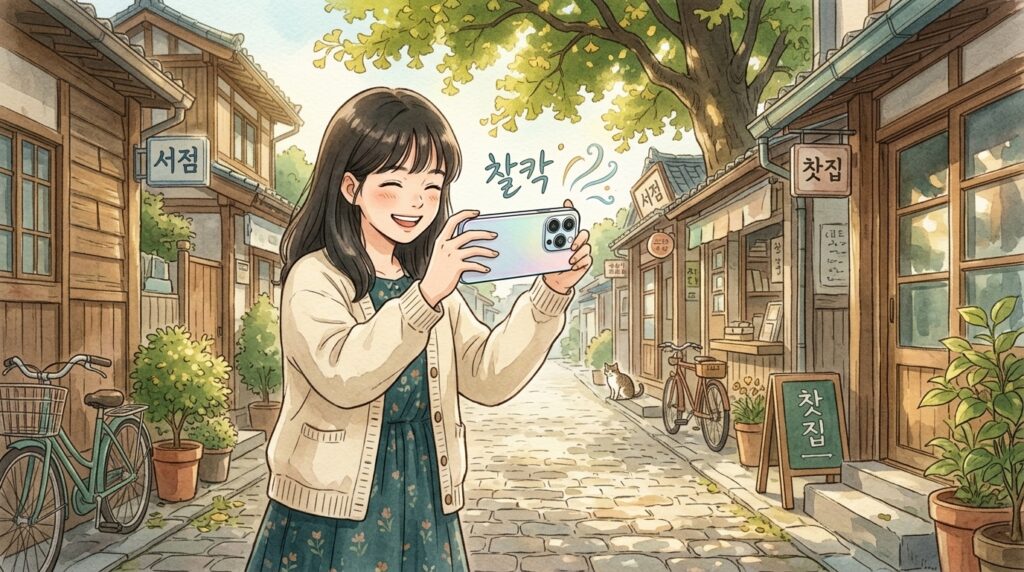
If you came of age with a film camera, 찰칵 feels natural. Correct, even. Of course a photo makes that sound; you’ve heard it ten thousand times, and it means “the moment is saved.” The fake click on your phone doesn’t grate on you. It reassures you.
Now pass the same phone to a sixteen-year-old who has never once held a film camera. To her, 찰칵 is meaningless — a vague, arbitrary beep bolted onto a silent device for no reason she can feel. And she isn’t wrong. She simply wasn’t part of the majority that decided what a camera “sounds like.” That noise was voted in by 다수 대중, the older crowd who knew the genuine article, and she inherited it without a ballot.
So which version is correct — the adult’s warm, self-evident 찰칵, or the teenager’s pointless beep? Neither. Both. It depends entirely on who’s listening, and the year they were born.
That’s where I stopped short. A sound isn’t natural. It’s merely familiar. And we spend whole lives mistaking the second thing for the first.
Two quick relics, then we leave the machines behind
The train. Korean 칙칙폭폭 (chikchik-pokpok), French tchou-tchou, English choo-choo — every one of them the chuff of a steam engine. The KTX and the TGV pull out of the station in dead silence at 300 km/h, and toddlers across three countries still reproduce the sound of a coal fire from 1910.
The microwave. Koreans don’t “microwave” food; they 돌리다 it, more precisely, “전자렌지에 돌리다, to spit (some food) in a microwave” — they spin it — a verb inherited from the rotating turntable, which a good half of today’s microwaves no longer even have. The food stays put. The word keeps turning.
Korean fossilises in sound. French and English fossilise in gesture. One camp remembers the machine by the noise it made, the other by the motion of the hand that worked it. Either way, nobody is describing the object actually sitting in front of them.
The loudest evidence is at the dinner table
Same principle — but step away from the machines. Now the sound is coming out of people.
In Korea you 후루룩 (hururuk) a bowl of noodles or hot soup. You slurp. The noise announces that you’re enjoying it, that the broth is good. At most tables it registers as warm and companionable, part of the meal rather than a breach of it. In front of the most senior boss you’d rein it in, of course. But among friends, family and colleagues, nobody bats an eyelid. The 후루룩 is a compliment you never have to put into words.
Do the same in a smart Paris restaurant. The neighbouring table concludes, in about half a second, that you were raised in a stable. In France — across most of the West — eating noises read as coarse. Unrefined. A judgment on your whole upbringing, delivered on the strength of a single sound.
Identical sound. Warmth on one continent, revulsion on the other.
Push it further. In some cultures a burp at the end of a meal is an affront. In others it’s a thank-you — a wordless message to whoever cooked that the food landed, a small tribute to the effort and to the person who fed you. Same burp, same air, same body, same reflex. One room hears bad manners. The other hears “your food was so good my body couldn’t keep quiet.”
Neither room is right. Both simply call familiar “natural.”
Now watch a sale unfold on Boulevard Haussmann
A friend of mine works a luxury-house counter inside one of the grand department stores on Boulevard Haussmann. She watches the two scripts play out every single day.
A French customer lifts a bag and asks: “Is it guaranteed? For how many years?” Reasonable. Very Western. I’m buying one item, and I want to protect it.
A Korean customer lifts the identical bag, tilts her head, and murmurs “heu…” Then silence. A pause.
To a salesperson who can’t read the code, that tilt spells trouble. She’s uncertain. She’s cooling off. She’s about to set it down and walk out.
Wrong. That tilt is the finest thing to land at the counter all afternoon.
The Korean customer isn’t fretting about the warranty. She never gives the warranty a thought. For her, the logo is the warranty. The brand is the guarantee, end of discussion. That question simply doesn’t exist in her head.
The tilt is her mental calculator powering up.
She didn’t come in for one bag for herself. She came in for four. Possibly ten. A gift for her mother. One for her mother-in-law. One for her boss. One for the nanny. Each with its own budget, its own weight, its own unspoken expectation. And there she stands, running the entire spreadsheet in real time. Same wallet for everyone, so no one can compare and feel slighted? Or two of the good ones here and three cheaper ones somewhere else? Who gets the bag, who gets the small leather goods, and what does each of those choices say about the relationship?
This isn’t shopping. It’s diplomacy with a receipt attached.
Gift-giving in Korea isn’t optional charm. It’s a social grammar. You give upward through the hierarchy and sideways across the family, and you give correctly, because the gift is a statement about respect, about rank, about how clearly you actually see the other person. Getting it wrong carries a real cost. So she calculates. Of course she tilts her head.
And here’s what the untrained salesperson misses completely: the Korean customer decided to buy before she ever crossed the threshold. The tilt isn’t “shall I?” It’s “how many, and in what order?” The French warranty question might close one sale. That silent Korean head-tilt might close six.
Same body language. Read it one way and you make the biggest sale of the day. Read it the other way and you’ve already lost it.
It was never only about sound
Set the noises aside entirely. The same trap lies waiting in the body.
A well-raised Korean laughs with a hand covering the mouth. Not out of shyness. You don’t expose the inside of your mouth, your throat, when you laugh out loud; the hand is the polite edit. To plenty of Westerners that hand looks timid, or insincere, or as though something is being hidden. It’s precisely the reverse. It’s someone who was taught how to behave.
Then the eyes. In Korea you don’t hold another person’s gaze, least of all someone older or more senior. Looking away is the respect. Holding the stare announces I’m challenging you. So a Korean junior lowers his eyes in front of the boss and means, unmistakably, “I respect you.”
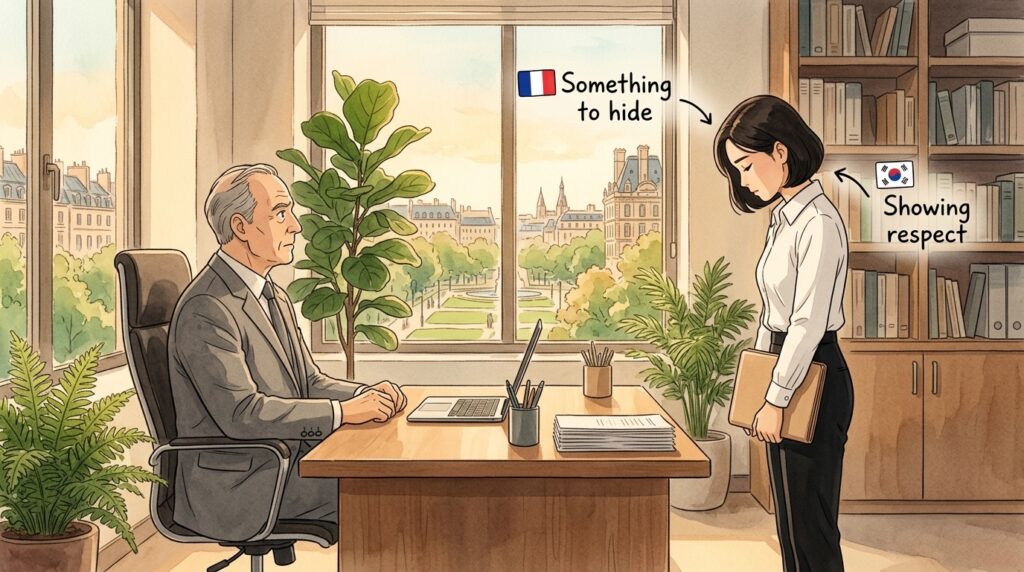
Now run that same junior past a Western manager. “Look at me when I’m speaking to you.” In the West, eyes that drop read as shifty, evasive, guilty, weak. The very gesture that signals respect in Seoul signals he’s hiding something in Chicago. Same eyes. Opposite verdict.
Nobody is lying. Nobody is rude. Two rooms simply learned to read the same face in reverse.
So what do we do with any of this?
I opened with toddlers and a passing car and assumed I was writing something light. I wasn’t.
We don’t each speak a single language. We speak several at once. The words. The noises we aim at machines. The slurp, the shielded laugh, the lowered eyes, the tilt of the head. Every one of them is a language, and every one shifts meaning depending on the country, the generation, the room, the year you happened to be born. What’s warm here is vulgar there. What’s respect here is defiance there. What’s confidence here is arrogance there.
Yes, this matters for HR, and for whoever is sitting across a negotiating table from you. But it stretches far past a hiring decision. It’s every moment two people from two histories read the identical gesture and walk away carrying opposite stories about who the other one is.
Which brings me to diversity and inclusion — because we’ve shrunk it down to almost nothing.
We turned D&I into a headcount sorted by skin tone. A photo that looks mixed enough to pass. Meanwhile the difference that actually matters — how people decline, grieve, laugh, defer, negotiate, show respect — goes entirely unread. That is the real diversity, and it’s invisible on a poster.
And while we’re here: retire “an Asian.” Retire “a European.” A North Asian is not a South Asian. A Chinese person, a Japanese person and a Korean person don’t share a culture, a code of manners, or a way of occupying a room — a Korean woman behaves nothing like a Japanese woman, and I mean nothing. It’s the same chasm as a French person and a Dutch one, or a Spanish woman and a German one: a different language of the face, the voice, the laugh, the meal. “Asian” is not a culture. “European” is not a personality. They’re coordinates on a map, and we keep mistaking them for people.
Real inclusion isn’t the label. It’s the wide view held together with a close eye — the willingness to zoom in when it counts. To register that the head-tilt is a calculation, that the lowered eyes are respect, that the slurp is a thank-you.
So before you write anyone off — before you settle on “rude,” “cold,” “arrogant,” “no EQ,” “not a fit” — sit with the possibility that you’re simply hearing their 빵빵 as your vroum. That the gesture you’re judging was handed to them as courtesy. That you might be the sixteen-year-old insisting the shutter has always clicked.
Decode first. Judge later, if you still feel the urge.
One last question before you go. The last time you were certain you’d read someone — their manners, their confidence, their respect for you — were you reading them? Or reading yourself?
If any of this made you re-hear a conversation you’ve already had, come tell me about it. I’m on LinkedIn most days, decoding two worlds out loud — and occasionally starting fights in the comments.
Connect with me on LinkedIn →
Leave a Reply