The launch that everybody approved
Let me give you a real one. I’ve changed the names and the house; I’ve changed nothing else, because nothing else needs changing. I have watched this meeting on three continents and in four companies.
The setup. A French beauty group — call it Lauvière. Paris headquarters. A new anti-ageing serum, eighteen months in development, launching in South Korea in the spring. Korea matters: it’s the market that decides whether a skincare product is taken seriously in Asia. Everyone knows the stakes. Nobody is stupid. Hold on to that — nobody in this story is stupid, and nobody lies.
The cast.
In Paris: Hélène, international director, twenty years in the group. François, 41, marketing lead, sharp, well-liked. Yumi Lee, 34, Korean, four years in the Paris office, French better than two people on her own team.
In Seoul, on the screen: 박 부장님 — Park bujang-nim, department head. Two juniors beside him, one of them a young woman named 지우 (Ji-woo). Ji-woo will not speak once during this story. Remember her.
14:00 — Who is allowed to talk
The call opens. And within ninety seconds, both sides have learned something wrong about each other.
On the Paris side, François interrupts Hélène. Mid-sentence. He says:
“Non, mais attends —”
(No, but hold on —)
This is not a crisis. In French, non, mais is not a refusal; it’s a doorbell. It means I am about to engage with you seriously. Hélène isn’t remotely offended. She fires back, he pushes, she concedes a point. Then someone says:
“Je ne suis pas d’accord.” (I don’t agree.)
To her director. Out loud. In front of a foreign client. And Hélène nods, because in a French room, contradiction is a compliment wearing a frown. Silence is what’s insulting — silence means you had nothing.
On the Seoul side, three people are watching a subordinate publicly contradict his superior in front of an external partner, and they are quietly appalled.
Not because they’re timid. Because in Korean, that isn’t disagreement. That’s a 체면 (chemyeon — face) injury delivered in public, and there is no way to undo it. You’ve cost your boss something in front of witnesses. The information could have been transmitted privately, at no cost to anyone, twenty minutes earlier.
So Seoul does what Seoul does. 박 부장님 speaks. Only 박 부장님 speaks.
Notice, by the way, that nobody says “Park.” Not once, not “Mr. Park,” not “Park-ssi.” He is 부장님 — bujang-nim, the title, plus 님, the honorific that makes it safe to address him at all. In Korean you don’t call people by their name at work. You call them by their position. The hierarchy isn’t in the org chart. It’s in the grammar. You cannot open your mouth without declaring where you stand.
And it’s not just rank. It’s age. 선배 / 후배 (sunbae / hubae — the one who entered before you, the one who entered after). Ji-woo entered in 2021. She sits after 2021 in every room she will ever be in with people who entered in 2019.
François looks at the two silent juniors and concludes: disengaged, or nothing to contribute.
Ji-woo used to work in cosmetics regulatory affairs. She has spotted, in the fourth slide, that Lauvière’s entire campaign is built on an anti-ageing claim — and that in Korea, claims like that sit inside the 기능성화장품 (gineungseong hwajangpum — “functional cosmetics”) category, which requires clearance from the ministry before you can say it out loud in an advertisement.
The campaign, as presented, cannot legally run in Korea.
Ji-woo knows this at 14:04. She says nothing, and she is right not to, because in her system a 후배 who corrects a room over the head of her 부장님 has not saved the company. She has humiliated her boss in front of a client, and everyone will remember the humiliation long after they’ve forgotten the serum.
The information exists. It’s in the room. There’s no door for it.
14:38 — The refusal that everyone hears as a yes
François presents the timeline. And here it comes. Watch closely, because this is the whole thing.
“네.” (ne — “yes”)
“네.”
“…네.”
Fourteen times, roughly. Every dictionary on earth will tell François that 네 means yes.
It doesn’t. Not the way he needs it to.
네 means: I’m here. I’m listening. Keep going. It confirms the line is open. It says nothing about the door. It’s the Korean equivalent of a French person going “oui, oui, oui” while you talk — nobody thinks that’s a contract either, but somehow, in another language, we forget.
Yumi confirmed the connection fourteen times. François heard fourteen agreements.
Then the timeline lands, and 박 부장님 says:
“검토해 보겠습니다.” (geomto-hae bogesseumnida — “we will review it internally”)
That is a no. Not a maybe. A no, delivered in full, in a form that costs nobody anything.
François writes down: they’ll review it. He is pleased. Reviewing is good. Reviewing is momentum.
Then:
“좀 어려울 것 같습니다.” (jom eoryeoul geot gatseumnida — “it might be a little difficult”)
That is also a no. The word “difficult” is not an invitation to help solve a difficulty. It’s a door closing politely. If you respond by offering solutions — and François does, enthusiastically, for four minutes — you have not been helpful. You have made the other person say no twice, which is exactly what the phrasing was designed to spare him.
And then the last one, the one that never survives a video call:
A pause.
Half a second in front of a yes. That’s it. That’s the message.
An immediate 네 is a yes. A 네 that arrives two beats late is a no wearing a yes. Koreans train this from childhood — it’s called 눈치 (nunchi), the ability to read a room and answer what nobody said. It is a graded skill; to be told you have no 눈치 is a real insult.
But nobody on the Paris side is listening to a silence, and half of them are on video with a 200-millisecond lag that eats the pause entirely.
Three refusals were delivered in thirty-eight minutes. All three arrived. None was received.
A brief detour, because someone else drew this map first
If any of the above is landing, you should stop reading me and go read Erin Meyer.

Meyer is an INSEAD professor and an American who’s lived in Paris for years — which makes her, structurally, my colleague. Another alien mapping the same terrain from a different planet. Her book The Culture Map plots cultures across eight scales: communicating, evaluating, persuading, leading, deciding, trusting, disagreeing, scheduling. It’s the reason a lot of people finally have words for what they’d been noticing for a decade.
Two of her scales explain everything that’s about to go wrong at Lauvière, and she explains them better than I can in one article:
On communicating, she puts France in the middle — not out at the explicit end with the Dutch and the Germans, where every “Western directness” cliché assumes France lives.
On evaluating — how you deliver criticism — she puts France at the blunt end, next to the Dutch, the Israelis and the Germans.
Middle of the context scale. Far end of the bluntness scale.
Sit with that, because it’s the least understood fact in European business: France is direct about disagreement and indirect about meaning. François is perfectly legible when he’s arguing and completely invisible when he’s agreeing. That’s not a contradiction. That’s the country.
Meyer also makes the point this entire article rests on: what matters isn’t where a culture sits in absolute terms, but where it sits relative to yours.
→ Read it: The Culture Map — Erin Meyer on amazon.com
https://amzn.to/456NfKY The Culture Map (on amazon.fr)
https://amzn.to/4feU6Xl La Carte des différences culturelles – 8 clés pour travailler à l’international (French version on amazon.fr)
I recommend it without reservation and I’ve handed it to more colleagues than I can count. It’s the best map available. My only note — and it’s not a criticism, it’s a difference of position — is that Meyer draws the map from above. I live on two of the squares. She’ll tell you where the difference is. I’ll tell you what it costs to be the difference.
(Affiliate link. If you buy through it I earn a small commission at no cost to you. I’d recommend this book if it paid me nothing, which for eleven years it didn’t.)
Back to Paris.
15:10 — Yumi tries. Yumi fails. This is the part that hurts.
The call ends. François is delighted. He uses the word fluide.
Yumi heard every one of the three refusals. She is the only person in the building who did. So she goes to tell them.
And here is where it becomes cruel, and where most articles about this stop.
Yumi doesn’t say “They refused. There is no deal.” She can’t. She’s junior, she’s the only Korean, and she has been trained since she was five that you don’t correct a room in front of the room. So she does it her way — correctly, by her rules. Privately. Afterwards. Softly.
She catches François by the coffee machine and says: “I think maybe the timeline was a little difficult for them?”
That sentence is a klaxon. In Korean, it is a screaming, unambiguous emergency broadcast. She used the word difficult. She said maybe, which means certainly. She raised it privately, which means this is serious enough that I’m protecting you from having to hear it publicly.
François says: “Ah, oui, peut-être. On verra.” (Ah, yes, maybe. We’ll see.)
He isn’t dismissing her. He genuinely didn’t hear it. In his system, an objection delivered by the coffee machine, hedged with maybe, is not an objection. It’s small talk. If it mattered, she’d have said it in the meeting, loudly, and he’d have respected her for it.
So: Yumi delivered a perfect warning through the exact channel her culture reserves for serious things — and that channel is, in France, the channel reserved for nothing.
She isn’t bad at French. She’s fluent. The words were never the problem.
This is the specific tax of being the person in the middle. Not that you’re misunderstood — that you’re understood as agreeable. Yumi will get a performance review that says “excellent team player, could show more initiative,” and she will read it and know exactly what happened, and there is no box on the form for it.
Three weeks later — the French no, which nobody sees either
Yumi, now genuinely worried, sends François the regulatory point. She’s done her homework. She’s found what Ji-woo found.
François replies:
“Oui, bien sûr. Je regarde ça.” (Yes, of course. I’ll look at it.)
He does not look at it. He was never going to. He decided within ten seconds that it wasn’t a priority, and oui, bien sûr is the sound a French professional makes while deciding exactly that.
It isn’t a lie. It’s politeness with a delay fuse.
She escalates to Hélène. Hélène says:
“C’est intéressant. On en reparle.” (That’s interesting. We’ll discuss it again.)
They will not discuss it again. C’est intéressant means it isn’t. On en reparle is a French burial, performed with full honours.
And then, the masterpiece:
“Il faut voir avec le juridique.” (You’d have to check with legal.)
Which sends the file into a corridor from which no file has ever emerged.
Nobody refused. Nobody ever refuses in France. The document simply stops moving, and the stopping is not attributable to any human being.
Here’s the structural reason, and it’s the thing that makes France genuinely strange: France scores 68 on Hofstede’s Power Distance Index — higher than Korea at 60, double Germany at 35. Steep pyramid. But France also scores 71 on individualism, against Korea’s 18. Hofstede’s own researchers flagged this as an anomaly — high power-distance cultures are supposed to be collectivist.
That combination produces exactly one behaviour, and every French employee will recognise it instantly: you comply in the room, and then you do what you personally think is right. Not out of malice. Out of a sincere conviction that you know better, which the hierarchy has never actually asked you to abandon.
So the French “yes” is real. It’s just a yes to the meeting, not to the work.
The autopsy
Spring. The campaign doesn’t run. It can’t — the claim needed a clearance nobody had filed for, and the filing takes months.
The launch is pushed. The Korean distributor, who has been quietly telling Paris “no” since February, moves on. Eighteen months of development lands in a market that has already stopped waiting.
The post-mortem deck contains the phrase “communication issues.”
There were no communication issues.
Everybody communicated perfectly.
박 부장님 refused three times in thirty-eight minutes, in flawless, complete, socially precise Korean. Ji-woo diagnosed the whole failure in four minutes and had nowhere to put it. Yumi issued a five-alarm warning through the channel her culture reserves for five-alarm warnings. François refused three weeks later, in one second, at his desk, while saying yes. Hélène refused with the word intéressant.
Five accurate messages. Zero received.
Nobody failed to speak. They failed to notice that yes isn’t a word.
Yes is a position on a map. And every one of them was reading a different map, absolutely certain it was the only one printed.
I’ve watched some version of this meeting for thirty years, from both sides of the mirror. And the standard explanation — Asians are indirect, Europeans are direct — is not just lazy. It’s wrong in a specific, expensive way.
Because the French said yes and meant no too.
They just meant it later.
How a Korean “no” actually sounds
A Korean colleague will almost never refuse you with a refusal. The refusal is real, it’s complete, and it’s fully audible — to another Korean.
Here is what it sounds like:
“We’ll review it internally.” — No.
“That might be a little difficult.” — No. Jom eoryeoul geot gatseumnida. The word “difficult” is not a request for help solving a difficulty. It is the closing of a door, said politely.
“Let me check with the team.” — No, unless a date follows in the same breath.
A pause before the yes. — This one matters most, and it’s the one that never survives a video call. The gap between your question and their answer is the message. An immediate yes is a yes. A yes that arrives two beats late is a no wearing a yes.
A change of subject. — No, and you’ve been given the courtesy of not being told twice.
None of this is evasion. It’s nunchi — the ability to read a room and respond to what wasn’t said. It’s a skill Koreans train from childhood and grade each other on. Saying “no” out loud, to a face, in front of others, isn’t honesty in that system. It’s a small act of violence. You’ve forced someone to lose face in public, and you’ve announced that you couldn’t read the room well enough to spare them the trouble.
The refusal was offered to you. You just weren’t listening at the right frequency.
France is not “the West”
Here is where the standard advice collapses.
Every guide to Korean business culture contrasts it with a generic “Western directness.” That contrast works for Amsterdam. It works for Stockholm. It does not work for Paris, and I would like the data on the table before anyone argues with me.
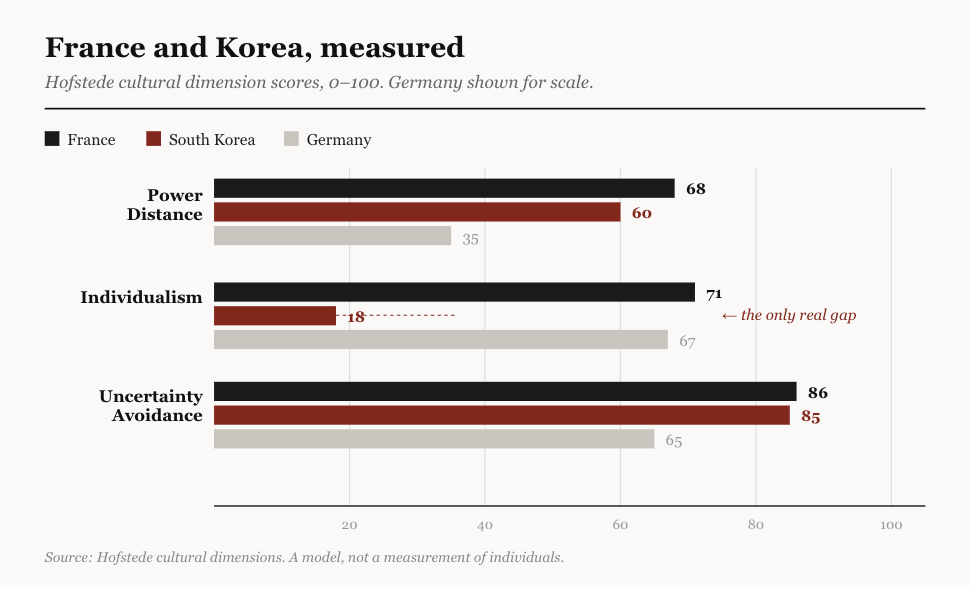
Caption: France scores higher on hierarchy than Korea. This surprises almost everyone, including the French.
Hofstede’s Power Distance Index — how much a society accepts that power is distributed unequally — puts France at 68. South Korea at 60. Germany at 35. Great Britain at 35.
France is more hierarchical than Korea. By eight points.
Uncertainty avoidance: France 86, Korea 85. Essentially identical. Two cultures equally allergic to ambiguity, equally fond of rules, procedures, and the properly stamped document.
There is exactly one real gap in this picture. Individualism: France 71, Korea 18.
That’s the whole story, and it’s not the story anyone tells. France and Korea build the same steep pyramid. They just fill it with opposite people. Korea puts a group at every level. France puts an individual — one who fully accepts the pyramid, and fully intends to do what he personally thinks is right.
Which produces the strangest thing in the French workplace, and the thing no Korean expects.
The French “yes” is also a no
France is a rare combination: high hierarchy, high individualism. Hofstede’s own researchers flagged this as an anomaly — high power distance cultures are normally collectivist.
What that combination produces is documented, and any French employee will recognise it instantly: subordinates comply with the boss in the room, and then, left alone, may quietly do the opposite of what they agreed to — because they believe they know better.
Read that again, and then reread the Korean list above.
Both cultures say yes in the room and mean no. The refusal exists in both. It is simply filed at a different moment.
[CHART 2 HERE — chart-2-timeline.svg]
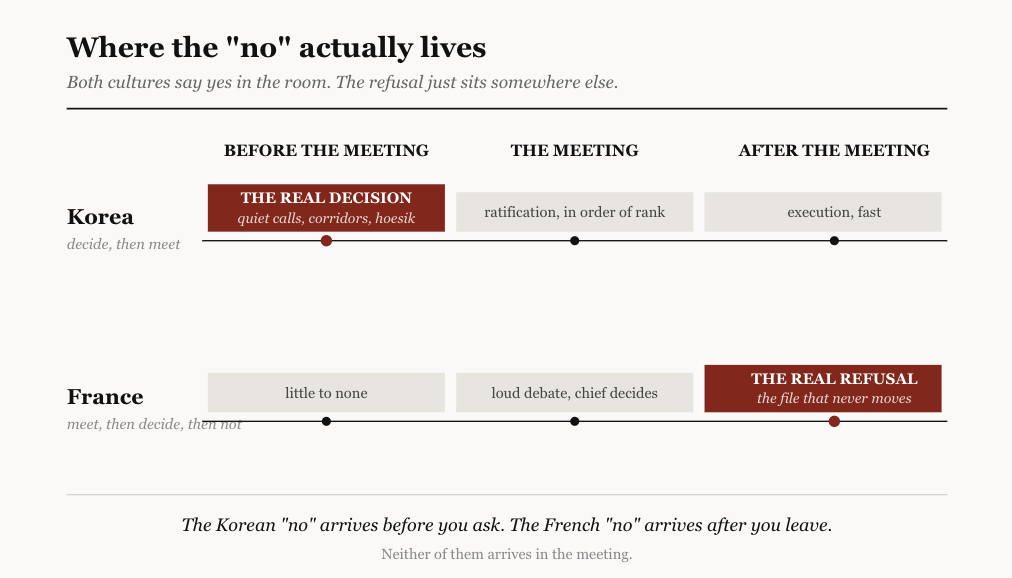
In Korea, the decision is made before the meeting. Calls, corridors, the dinner. By the time everyone is seated, the outcome exists; the meeting ratifies it in order of rank. So the “no” reaches you early — encoded, softened, but early. If you can read it, you have information before you’ve spent a euro.
In France, the meeting is the theatre. It is loud. People contradict each other, and contradicting your boss out loud is not insubordination — it’s evidence you’re thinking, and it’s closer to a compliment than an insult. Then the chief decides, alone, because PDI 68. And then the individualism arrives: the file simply stops moving. Nobody refused. Nobody ever refuses. The document just enters a corridor and does not come out.
The French no is not softer than the Korean one. It’s slower, more expensive, and it doesn’t warn you.
The Korean no costs you a week. The French no costs you a quarter.
Who is allowed to speak
The hierarchy is the same height in both countries. The rules for opening your mouth inside it are not.
| Korea | France | |
|---|---|---|
| Ranking is based on | Rank, then age. Both, always, immediately. | Rank, then diploma. The school stays on the CV forever. |
| Speaking order in a meeting | By seniority, top down. Real, and visible. | By seniority, roughly — but a junior with a good argument can jump. |
| Contradicting the boss in public | Costs face. His, and yours. Avoid. | Expected. Silence reads as having no ideas. |
| Where disagreement is voiced | Privately, before. Or through an intermediary. | Publicly, during, at volume. |
| What the meeting is for | Confirming a decision already made. | Performing a decision about to be made unilaterally. |
| Real veto power | The senior, and the group’s silence. | The chief, and afterwards, everyone’s inaction. |
| The dangerous signal | The pause. | The enthusiasm. |
The last row is the one to keep. A Korean who hesitates is telling you something. A French colleague who is very enthusiastic in the room is telling you nothing at all — and possibly the opposite.
What to actually do
- Time the silence. In a Korean meeting, count the beat before the answer. That beat is data. It is often the only honest thing in the room, and it costs nothing to notice.
- Never ask a yes/no question to a group. Ask “what would need to change for this to work?” You’ll get a real answer, because it lets everyone stay polite while telling you the truth.
- Find the pre-meeting. With Korean partners, the meeting isn’t the negotiation — it’s the announcement. If you’re not in the conversation that happens before, you’re not negotiating. You’re being informed.
- In France, distrust the room and watch the calendar. Agreement in the meeting means nothing. Movement in the following two weeks means everything. Set a date and a name in the room, out loud, or you will get the corridor.
- Stop using “direct vs. indirect.” It’s the wrong axis and it will cost you money. The real question is when the refusal is filed, not whether it exists. It always exists.
Frequently asked questions
Are Koreans dishonest in meetings? No. The refusal is delivered in full — through timing, hesitation, and hedged phrasing. In a high-context culture, that is the message, not a decoration on top of one. The information was transmitted. The failure was at reception.
Is France a direct culture? Partly, and only in one direction. The French are direct about disagreement — argument is a social good and contradiction reads as engagement. They are not direct about refusal. A French no is frequently expressed as silence, delay, or a file that stops advancing.
Is France really more hierarchical than Korea? On Hofstede’s Power Distance Index, yes: 68 versus 60, against Germany and Britain at 35. The models are aggregates and shouldn’t be applied to individuals. But the direction is stable, and it explains more about French organisations than most French organisations would like.
How do I get a real answer from a Korean colleague? Ask privately, one to one, with no audience. Face is only at risk when there are witnesses. The candour available in a corridor is not available in a conference room, and this is true in Seoul and Paris both.
The mirror
The French team left that Paris meeting saying it went well. The Korean team left having already declined.
Both sides had said yes. Both sides meant no. One side had filed the refusal three days before the meeting; the other would file it three weeks after. Neither of them had lied. Neither of them had listened.
The gap between cultures is rarely about who speaks plainly. It’s about where each one keeps its “no” — and everyone assumes theirs is the natural place to keep it.
So: where does your organisation keep its no? And how long does it take anyone to find it?
I’m a Korean alien living in France — an outsider who sees both sides of the mirror. Thirty years in international beauty marketing taught me that most cross-border failures aren’t strategy failures. They’re translation failures nobody logged.
You may be interested in this article : From National Gift to a $165 Million Loss: The Full Autopsy of Starbucks Korea’s “Tank Day” Crisis https://gangnamrivegauche.com/index.php/2026/07/15/starbucks-korea-tank-day-brand-crisis/
More decoding of what gets lost between Seoul and Paris: [subscribe to the newsletter] · [follow Gangnam Rive Gauche on LinkedIn]
Leave a Reply