
I’m a Korean alien living in France. I’ve spent decades living and working in France, bridging two entirely different corporate realities.
Right now, there is a fracture in how the world is handling artificial intelligence. It isn’t about regulation. It isn’t about the technology itself. It is about fear. Just two very different kinds of it.
When I speak with my colleagues in Seoul, the AI conversation is entirely tactical: “What tools are you using? How much time does it save you?”
When I have the same conversation in Paris, it hits a wall of institutional skepticism: “It’s just a fancy autocomplete. Besides, management is going to use this to cut headcount.”
There is a cultural instinct in Europe that dictates that technology doing the thinking for you is somehow illegitimate. That human craftsmanship is the only valid currency.
This isn’t a verdict on which side is right. It is an observation of a global workforce split by two psychological extremes: Fear Of Missing Out (FOMO) and Fear Of Losing (FOL).
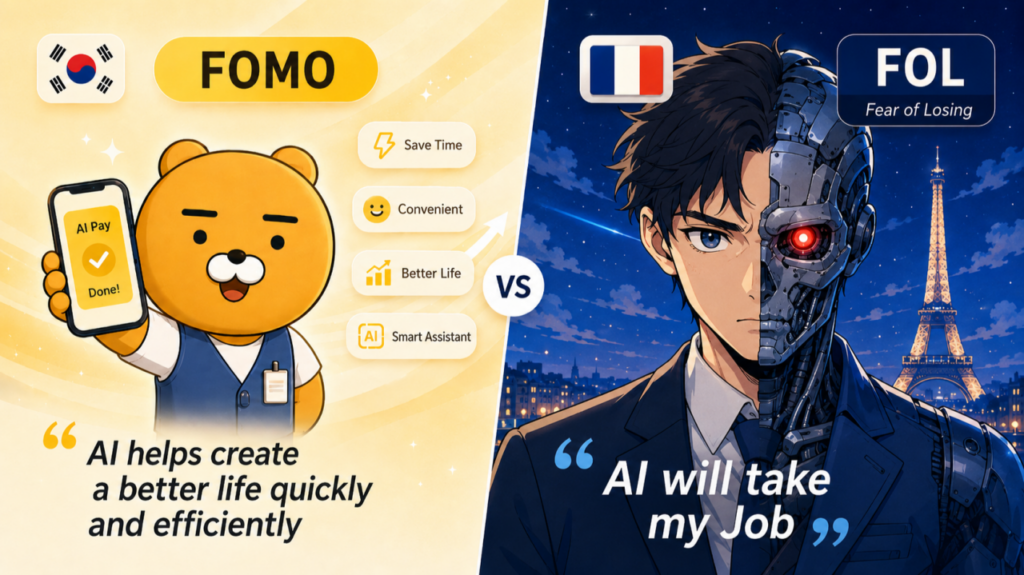
The Anatomy of FOMO: South Korea’s Acceleration Anxiety
To understand Korea’s relationship with AI, you have to look at Hyun-soo.
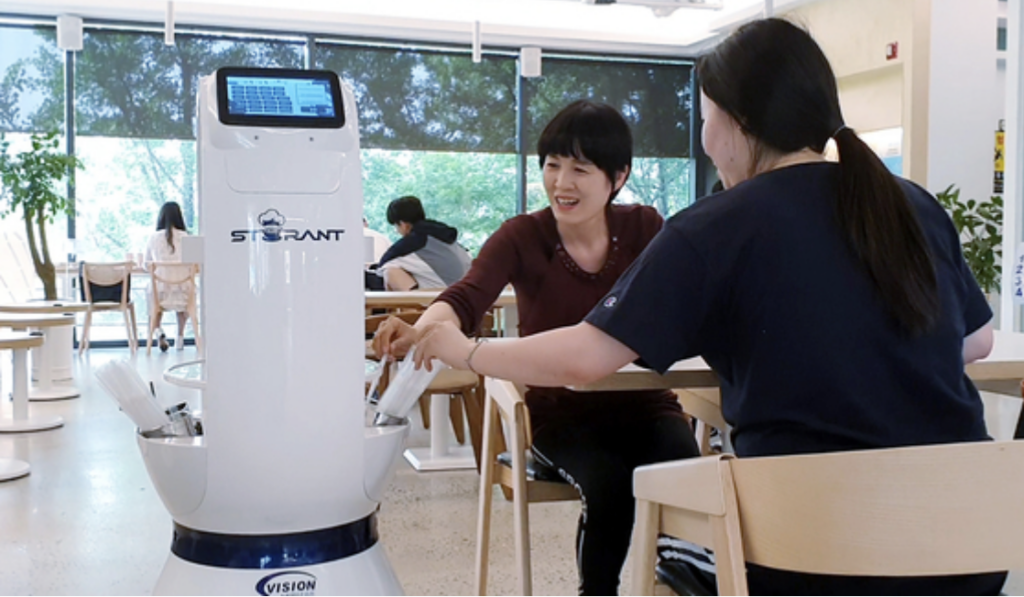
Hyun-soo is a marketing professional in Seoul. He eats lunch in 30 minutes at a restaurant where a kiosk takes his order, a robotic arm fries his chicken, and a machine rolls the tray to his table.
After his kids go to sleep, he starts his second shift. Hyun-soo is an “N-jobber.” He uses ChatGPT to draft scripts, Midjourney for thumbnails, and Suno AI for background music to pump out affiliate marketing videos. He makes an extra €700 a month—exactly enough to cover one child’s hagwon (private academy) fees.
He isn’t a tech evangelist. He is a parent surviving one of the most ruthless labor markets on earth. In a system that never slows down, standing still is a luxury nobody can afford.
That is FOMO.
The result? 61.5% of South Korean workers use AI on the job. That is the highest workplace adoption rate in Asia, completely dwarfing the 26–36% seen across the EU (Bank of Korea, 2025; European Commission, 2025).
Robots in senior care homes and AI drafting tax returns aren’t viewed as a dystopian nightmare in Seoul. They are the obvious logistical response to a society that doesn’t have enough hours in the day.

And yet, 35.4% of Korean workers actively fear that new technologies will cost them their jobs. They love the technology, and they are terrified of it. That is what acceleration anxiety feels like: jumping on a bullet train you believe in, completely unsure if you can hold on.
The Anatomy of FOL: Europe’s Protective Fortress
I don’t think my French colleagues are wrong to be cautious.
They operate inside a completely different architecture. In France, employment is built around stability, permanent contracts (CDI), and the institutional weight of accumulated expertise.
When a generative AI tool compresses six days of strategic analysis into thirty minutes, it doesn’t read as good news. It reads as a direct threat to the value equation of human labor.
“Why should I change when everything seems OK?” “I do not trust things I do not understand.”
This is FOL: Fear Of Losing. It is not the fear of being left behind by your peers. It is the fear of watching what you spent twenty years building suddenly become commodified.
The economic anxiety is entirely rational. The German Institute for Employment Research projects that 1.6 million jobs will be reshaped or eliminated by AI in Germany alone. The EU AI Act, the world’s most ambitious regulatory framework, was built on a singular, culturally European premise: fundamental rights before corporate speed.
The Epidemic Nobody Admits: Shadow AI
Here is the punchline. The fear doesn’t actually stop people from using AI. It just drives it underground.
Currently, 57% of employees worldwide admit to hiding their AI usage from their employers (Withum AI, 2025).
In Korea, they hide it to move faster than the system allows. In France, they hide it to avoid the social cost of being branded a “cheater” who doesn’t do “real work.”
Different fears. Same shadow.
The corporate cost of this silence is brutal. According to Unseen Security (2026), 68% of organizations have already experienced data leaks because employees quietly fed sensitive, proprietary information into unvetted AI tools. Companies are so busy debating whether they should adopt AI that they haven’t realized their employees already did it on their personal phones.
The Four Corners of the AI Map
We are all standing on a grid with four coordinates:
- “I Like” (The Enthusiast): AI genuinely saves me time. I adopt it freely, not from fear.
- FOMO (The Survivor): I use AI because I cannot afford not to. The pressure is real. (The Korean default).
- FOL (The Protector): I’ve built expertise that matters. AI threatens its value. I resist to protect my craft. (The European default).
- “I am Afraid” (The Anxious): AI will cost me my job and stability. I reject it out of raw economic terror.
The difference between Korea and France isn’t that one is brave and the other is timid. It is that hyper-competitive employment makes FOMO rational, while highly structured employment makes FOL equally rational.

The goal for any global strategist isn’t to force a French team to act Korean, or vice versa. If you try to sell AI as a “speed and survival” tool in Europe, you will hit a wall of psychological resistance. If you don’t lead with speed in Korea, you will be ignored.
The real goal is to get your team to stop hiding.
Take a look around your own office tomorrow morning. Which fear is secretly running the room?
I’m a Korean alien living in France—an outsider who sees both sides of the mirror. I write about the collisions between culture, marketing governance, and corporate reality.
Want the raw, unfiltered analyses I cannot post on professional networks? [Subscribe to Gangnam Rive Gauche on Substack] Never miss a deep dive: [Follow the Gangnam Rive Gauche LinkedIn Page]
Read another facinating story : They used AI to save time. It cost them $165 million, 1.13 million users, and thirty years of brand equity. The complete autopsy of the Starbucks Korea catastrophe.
Leave a Reply