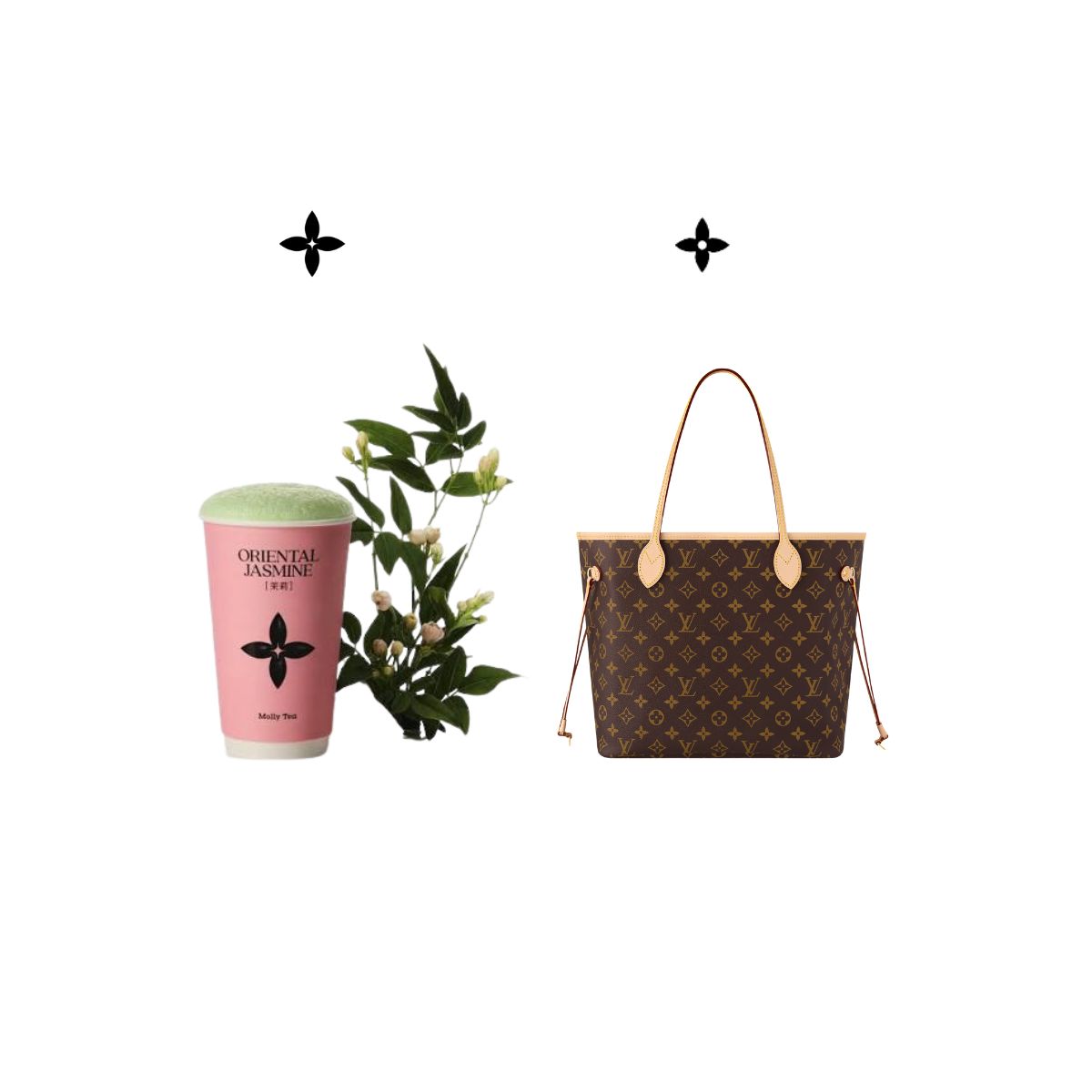
I put the two pictures side by side on my screen and zoomed in.
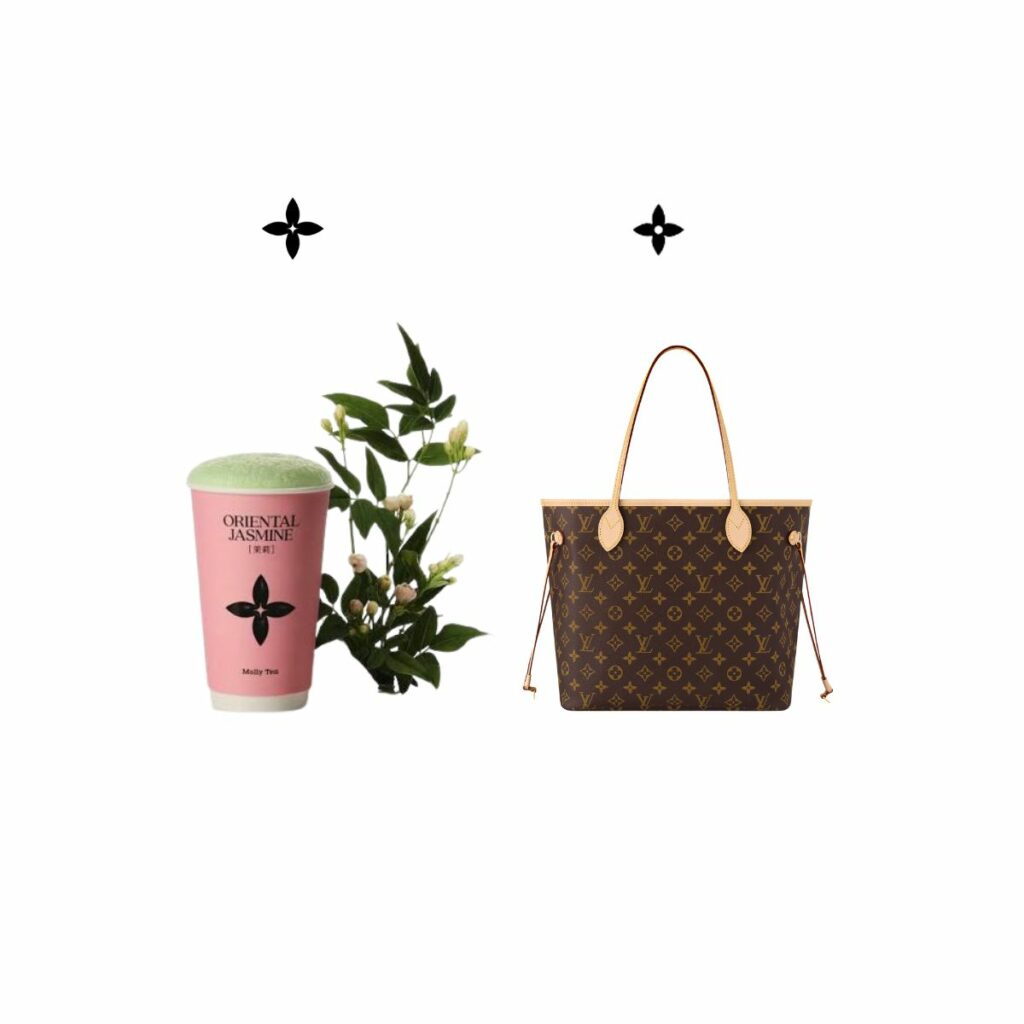
One is a four-petal flower on a €1,550 handbag. The other is a four-petal flower on a 15-yuan cup of Jasmine tea. About two dollars.
Then I opened a third image. A rosewood pipa from the Tang dynasty, 1,300 years old, covered in four-petal flowers. The Chinese internet had already found it. Of course they had.
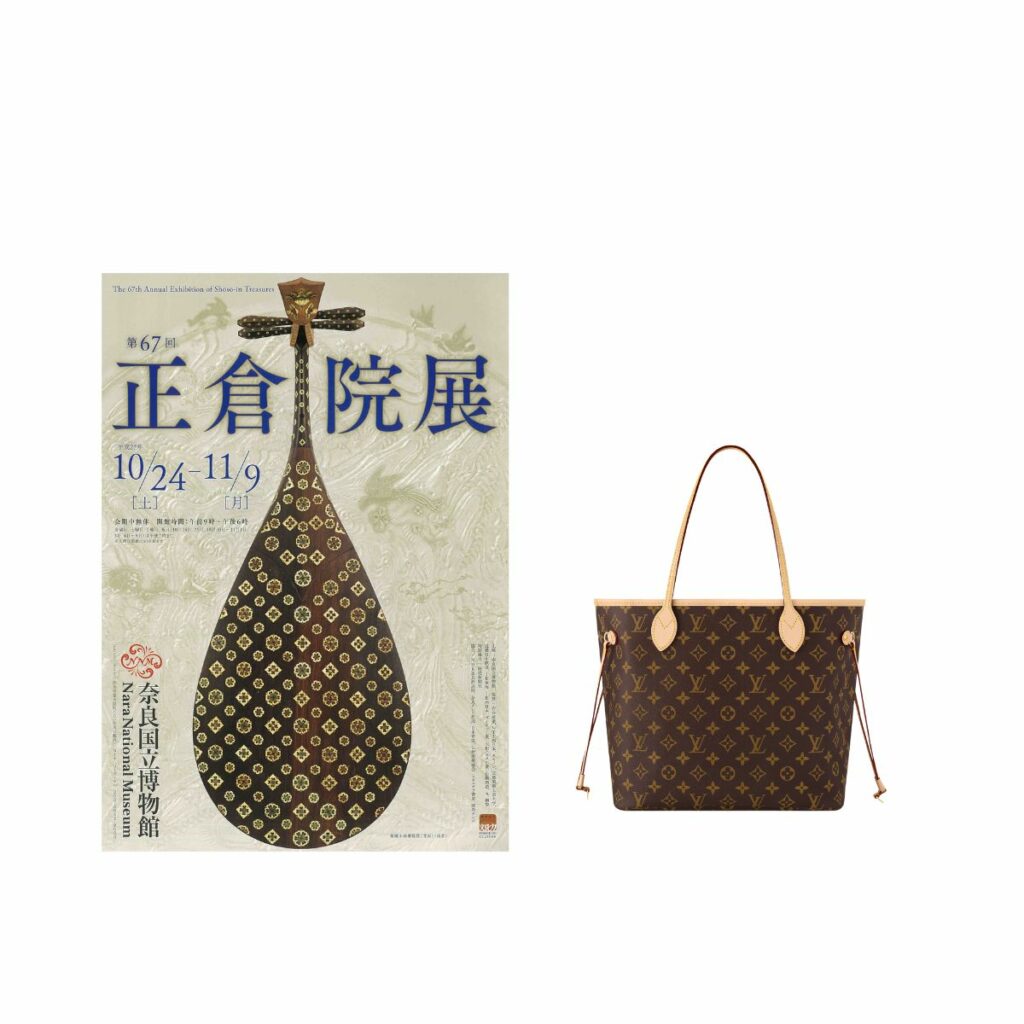
Three flowers. One of them is now worth 10.3 million yuan.
I have spent thirty years in luxury and beauty marketing, mostly inside the French system. I know exactly what Louis Vuitton was protecting, and I think they were right to protect it. I also think they picked the worst possible year to do it, in the worst possible market, over the worst possible shape.
And here’s the part almost nobody wrote about: the loser handled it better than the winner.
What actually happened
Louis Vuitton Malletier filed suit in May 2025 against Shenzhen Molly Tea Catering Management Co. and one franchised store in Suzhou’s Wuzhong Economic Development Zone. The case was accepted on 15 May 2025.
The Suzhou Intermediate People’s Court handed down its first-instance judgment on 29 June 2026. Per Jiemian’s reporting, the court found infringement on seven of Louis Vuitton’s registered four-petal flower trademarks — the components of the Monogram, not the Monogram as a whole.
The bill: 10 million yuan in economic damages, plus 300,000 yuan in rights-protection costs. Roughly $1.5 million. Payable within ten days. The franchise store carries joint liability capped at 100,000 yuan.
The court also ordered Molly Tea to post a corrective statement on the homepage of six official channels — website, mini-program, Weibo, WeChat, RedNote, Douyin — to neutralise the effect of the infringement.
Molly Tea said it would appeal. Louis Vuitton declined to comment.
Two facts from the file that most coverage skipped, and that decide the whole case:
One. From March 2024 onward, Molly Tea and affiliated entities filed multiple trademark applications with the China National Intellectual Property Administration covering the floral design — restaurant services, advertising, convenience foods. Almost all were rejected. Only the mark containing the Chinese characters 茉莉奶白 registered.
They kept using the flower anyway. For two more years. Across thousands of stores.
Two. The logo wasn’t an accident in a back office. According to posts from the studio’s own Instagram, the packaging containing that flower was created in 2023 by Tenkiiiii Design, a Shenzhen studio that specialises in “oriental aesthetics” for Chinese food and beverage start-ups.
A studio built to render Eastern aesthetics produced a mark that a Chinese court has now ruled belongs to a French house. Sit with that for a second. We’ll come back to it.
The flower nobody owns, and everybody registered
Here’s where a milk tea case became a national argument.
The verdict topped Sina Weibo. Global Times reported 350 million views on the trending topic within a day. The South China Morning Post put the total at 400 million views, alongside a hashtag translating roughly to Molly Tea lost the lawsuit but won the public’s heart — 30 million views on its own.
Beijing Daily, state-owned, asked on Weibo why a Chinese company was paying more than ten million yuan to a French company for a design that echoes centuries-old Chinese patterns. Global Times ran a headline saying netizens accused Louis Vuitton of trying to monopolise ancient motifs, and reported widespread frustration that a foreign brand controls a design many consider Chinese heritage. Fortune’s coverage noted the accompanying image: a Tang dynasty pipa’s inlay, side by side with the Monogram.
The motif Chinese commenters pointed to is the baoxiang flower — the treasure-appearance flower, a stylised composite bloom that runs through Tang dynasty architecture, textiles, and instruments from roughly the seventh century onward.
And now the part that makes this a Gangnam Rive Gauche story rather than a legal brief.
Louis Vuitton is currently celebrating 130 years of the Monogram. Georges Vuitton drew it in 1896, four years after his father died, specifically as an anti-counterfeiting device — a pattern complex enough that copyists would fail. LVMH’s own communication describes it as inspired by neo-gothic ornamentation and the influence of Japonisme.
Japonisme. LVMH says it themselves, in writing, on their own site.
Late nineteenth-century Paris fell in love with Japanese design after Japan opened to the world. Ukiyo-e prints, ceramics, textiles — and kamon, the Japanese family crests: geometric, symmetrical, radially perfect. There is no archival document proving Georges copied kamon. Historians usually credit neo-Gothic quatrefoils, the kind carved into every cathedral in France, and Art Nouveau’s floral obsession. There’s even a charmingly domestic theory that he was looking at the kitchen tiles in the family house at Asnières, which carry thistles, four-petal flowers, and a diamond pattern.
So: nobody can prove the Monogram came from Asia. Nobody can prove it didn’t. Officially, it’s a French pattern drawn by a Frenchman in a Parisian workshop during a decade when all of Paris was obsessively studying Asian ornament.
That is the whole argument, and it is unresolvable, and that is precisely why it detonated.
Because a four-petal flower is not an invention. It’s a default. Humans have been drawing four petals in a square since we started drawing. Gothic cathedrals have it. The Tang had it. Japanese crests have it. Islamic tilework has it. Your bathroom floor probably has it.
Louis Vuitton didn’t invent the shape. They registered it. Then they defended the registration for 130 years while everyone else was busy having culture instead of paperwork.
I’m a Korean alien living in France. I know this specific feeling in my spine. It’s the feeling of watching something from your side of the world get admired, abstracted, filed, and sold back to you at a 900% markup — and then being told, correctly, by a court, that you’re the one infringing.
Both things are true at once. That’s what makes people furious. The court was right. The internet was also right. They were answering different questions.
The numbers
- 10.3 million yuan — total damages ordered (10M economic + 300K costs). About $1.5 million
- 7 — Louis Vuitton four-petal flower trademarks found infringed
- 10 days — payment deadline from the judgment taking effect
- 6 — official channels required to carry a corrective statement
- 400 million — Weibo views on the verdict (SCMP)
- 30 million — views on the “lost the lawsuit, won the public’s heart” hashtag
- 40% / 25% — negative vs. positive sentiment for Molly Tea post-verdict, per CARMA — with the positive bloc reading the lawsuit as cultural overreach and buying tea as a protest
- 2,300+ — Molly Tea stores in mainland China, ~50 overseas (WWD)
- 2021 — year Molly Tea was founded, in Shenzhen, by Zhang Bochung
- 1896 — year Georges Vuitton drew the Monogram, as an anti-counterfeiting measure
- ~100 million yuan — Molly Tea’s October 2024 financing round, led by Alibaba’s local-life business
- €19.1 billion — LVMH Q1 2026 revenue, +1% organic, -6% reported
- -2% — LVMH Fashion & Leather Goods organic growth, Q1 2026
- 32% — share of LVMH revenue from Asia excluding Japan, the group’s single largest region
- 35% — Fashion & Leather Goods operating margin, FY2025
- 25,000–40,000 yuan/month — salary Molly Tea is now offering for an IP-focused legal manager in Shenzhen, 14-month structure
That last one is the whole article in one line, and we’ll get there.
Why a $1.5M flower is not a rounding error
Now the part I actually came here for. The margin.
A luxury handbag that retails at €1,000 costs a fraction of that to make. Leather, hardware, hours, a workshop, a supply chain. Real costs, real craft — I’m not doing the tired “it’s all markup” routine. But the gap between the cost of the object and the price of the object is not covered by leather. It’s covered by meaning.
The Monogram is the margin. The motif, the colour language, the visual grammar — that’s the part the customer is buying. LVMH ran a 35% operating margin in Fashion & Leather Goods in 2025, in a down year, in a sector everyone keeps declaring dead. That number is not manufactured in Asnières. It’s manufactured in the semiotics.
Semiotics only hold if the sign stays scarce.
Put an LV-adjacent four-petal flower on 2,300 milk tea counters and the distance collapses. Not because anyone confuses a tea shop with a Maison — that’s the argument everyone made on Weibo, and legally it’s weaker than it sounds. The damage isn’t confusion. It’s familiarity. Luxury dies of familiarity long before it dies of confusion.
And there’s a harder legal reality underneath the commercial one. Trademarks are not property you own the way you own a house. They’re territory you hold by patrolling it. A mark that isn’t defended erodes — first in distinctiveness, then in enforceability. Aspirin, escalator, thermos, cellophane: all of them were once somebody’s trademark. All of them lost, not to a competitor, but to everyone.
So Louis Vuitton’s legal department doesn’t get to be gracious. If they let the tea flower stand, the next defendant cites the tea flower. Then the next. Enforcement isn’t optional; it’s the maintenance schedule on a 130-year-old asset. LV declining to comment isn’t arrogance either — anything they say makes the trend worse.
Brand dilution is margin erosion. That’s what LV was actually suing over. Not a flower. A P&L line.
I’d add one more layer, because a Korean alien in France notices this and a French lawyer might not: the timing was a strategic decision, and it was a bad one.
Asia excluding Japan is now 32% of LVMH’s revenue — the group’s largest region, growing +7% organically in Q1 2026 while Europe and Japan fell 3%. Fashion & Leather Goods, the division that owns the Monogram, was negative 2%. LV opened a Beijing flagship. It opened LV The Place Seoul. It built The Louis in Shanghai — a boat-shaped cathedral to the brand. The entire growth thesis rests on Chinese and Korean consumers deciding this French house is worth the premium.
And in the middle of that — in the middle of a jubilee year spent telling the world that the Monogram is a universal symbol of creativity — they took 10.3 million yuan off a jasmine tea chain for a flower. In the country whose consumers are the growth story.
Legally airtight. Culturally, they walked into a fan blade. 400 million views of “the French are taking our ancestors’ patterns” is not free. It doesn’t show up in Q3. It shows up in five years, in the slow drift of what a twenty-two-year-old in Chengdu thinks the Monogram means.
Here’s the question nobody at that approval meeting asked, and I’ve sat in enough of those rooms to know: what does winning cost?
The anatomy: Molly Tea built a global brand before it built a legal one
Let’s be honest about the defendant, because the sympathy narrative is doing a lot of work here.
Molly Tea is not a village tea stall run over by a French tank. Founded 2021 in Shenzhen. Over 2,300 stores in mainland China and around 50 abroad by 2026 — US, Canada, Australia, UK, Thailand, Indonesia, Singapore. Alibaba’s local-life arm led a nine-figure-yuan round in October 2024. Their first Flushing store reportedly ran around $500,000 a month, well above the $150K–$300K typical for a Chinese tea brand in North America. Salt Lake City’s opening hit $35,000 in a single day and over 5,000 cups.
They built a serious brand. The “Eastern Modern” aesthetic. The jasmine-first product thesis. A mascot named Molly. Collabs with Hello Kitty — over a million cups of the co-branded melon oolong in five days, merch gone in ten minutes — plus Barbie, My Little Pony, Garfield.
And, in 2024, a collaboration with L’Oréal. Face masks and milk tea. I spent a large part of my career inside that ecosystem, which is the kind of detail that makes you laugh out loud alone at a desk in Paris. The French beauty group co-brands with them. The French leather group sues them. Same country of origin. Different departments of the same civilisation.
Now the failure chain, which is textbook and depressingly ordinary:
2023 — an outside studio designs the packaging. The flower ships. March 2024 onward — they try to register the flower. CNIPA rejects application after application. Only the Chinese characters get through. 2024–2026 — they keep the flower. They scale it to thousands of stores, six digital channels, and eight countries. May 2025 — LV files. June 2026 — the bill.
A rejection from your own national IP office is not bureaucratic noise. It’s the state telling you, on paper, in advance, that your mark is not distinct enough to be yours. They received that answer repeatedly and treated it as an administrative inconvenience rather than a strategic alarm.
Meanwhile, the same period, the New York situation. In June 2026 several Molly Tea stores in New York taped over their signage with a large black question mark and traded as “? Tea,” following an SDNY preliminary injunction in the brand’s contract fight with its US operating partner. Flushing, Brooklyn, Manhattan Chinatown, the Columbia store. Customers turned up to photograph the punctuation.
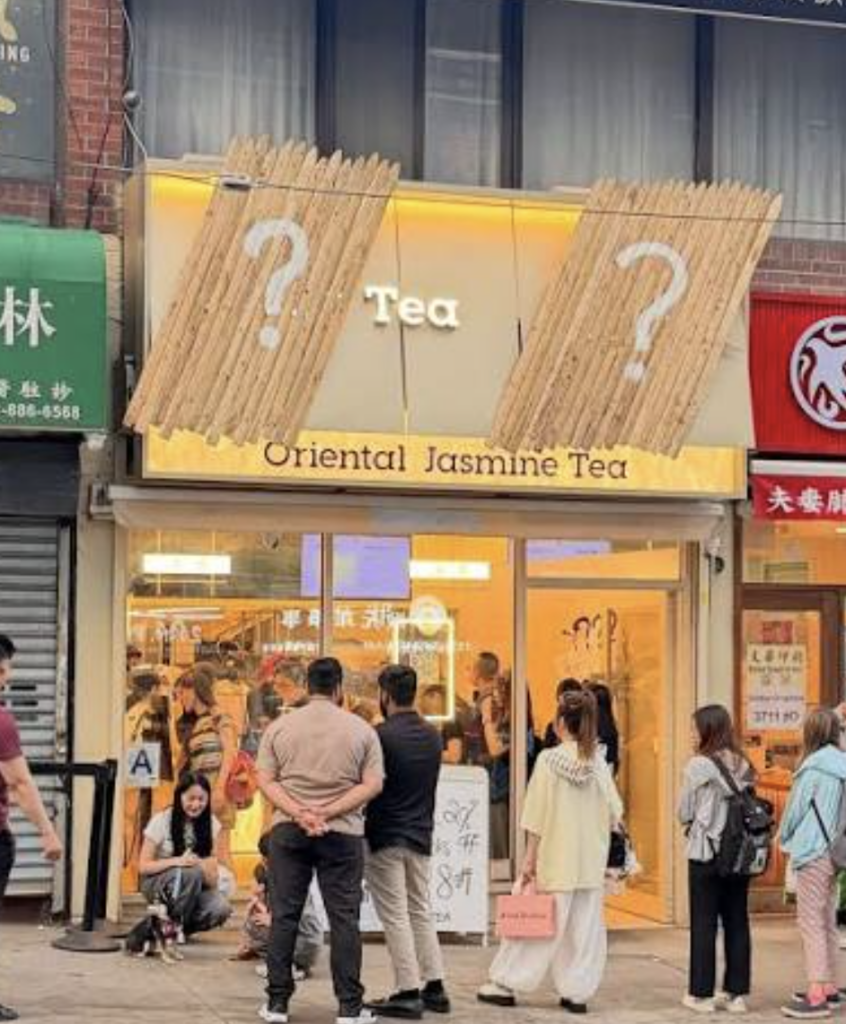
Two separate legal crises. Same quarter. Both about who controls the brand. Neither about tea.
This is not a budget problem. They had Alibaba money. They had 2,300 stores. They had the highest-performing overseas debut in their category. They could afford a trademark strategy the way I can afford a metro ticket.
They just didn’t build one until it cost them 10.3 million yuan. And I know this exactly, because the job posting is public: Molly Tea is now recruiting a legal manager for intellectual property in Shenzhen — trademark system, global IP layout, administrative disputes — at 25,000 to 40,000 yuan a month, fourteen months a year.
That role, filled in 2023, costs about half a million yuan a year. The absence of that role cost 10.3 million yuan, six public apologies, and a rebrand.
And yet: the loser recovered faster than the winner
Here’s where I part company with most of the commentary, which treated this as a straightforward story of the giant crushing the ant.
Watch what Molly Tea actually did.
Within days, the logo changed. Black-and-white to purple. Flat to three-dimensional. Gold accent at the bottom of the interface. Customer service attributed it to “operational adjustments” and did not mention the lawsuit at all. Marketing-Interactive reported the rollout; the queues did not move.
Jacopo Pesavento of Branding Records called it weak — touch-up work, a brand surviving a lawsuit rather than earning back trust, keeping the exact silhouette that got them sued. He’s not wrong about the design. I think he’s wrong about what we’re watching.
Because that speed is the story. A brand with 2,300 storefronts, six digital channels, packaging, cups, aprons, signage, delivery-platform listings — and it swapped its central visual asset in days without losing the queue.
You cannot do that unless your equity was never in the logo.
Molly Tea’s equity is the jasmine. The seven-step scenting. The “Eastern Modern” identity. Molly herself. The Hello Kitty drops that sold out in ten minutes. The cultural position they spent five years earning. The flower was decoration sitting on top of an actual brand.
Test it in reverse: take the Monogram off Louis Vuitton. What’s left?
A great deal, actually — leather, heritage, Asnières, the ateliers. But not €1,500. Not a 35% margin.
The irony is almost too neat. Louis Vuitton is so dependent on its motif that it must spend a jubilee year and a courtroom defending four petals in Suzhou. Molly Tea is so undependent on its motif that it dropped it over a weekend and kept selling tea.
One of these companies had a logo problem. The other had a logo.
And on the way out, the market handed Molly Tea something LV cannot buy: a 25% positive sentiment bloc that reads the lawsuit as cultural overreach and now buys jasmine milk tea as a small act of national loyalty. CARMA measured it. They lost 10.3 million yuan and acquired a martyrdom narrative in the world’s most important consumer market.
That is not a defeat. That’s the most efficient marketing spend of their year, and they didn’t even choose it.
Five lessons
1. Your trademark is a P&L line, not a legal line. If your margin depends on meaning, the mark that carries the meaning is a revenue asset. It belongs on the CFO’s dashboard, not just in the legal department’s filing cabinet. Louis Vuitton understands this perfectly — which is why they sued, and why they had no choice.
2. A rejection from an IP office is a strategic alarm, not a form to refile. Molly Tea’s applications were refused starting March 2024. They kept scaling the shape for two more years. Every rejection is your own government telling you, free of charge, that you are standing on someone else’s ground. The cheapest lawsuit is the one you settle by redrawing something in 2023.
3. Build the equity underneath the logo, so the logo is survivable. The real question isn’t “is our logo protected?” It’s: if a court ordered us to change our logo tomorrow, would we still have a business on Monday? Molly Tea could answer yes. Most brands can’t, and don’t know it until the letter arrives.
4. Winning legally and winning culturally are two different budgets — and only one of them is on the invoice. LV won 10.3 million yuan and 400 million views of an argument they cannot win. In a market that is now 32% of their group revenue. Before you enforce, model the cultural cost the way you’d model the legal cost. Somebody in that room should have been paid to ask.
5. Whoever registered the shape owns it. Whoever remembers the shape doesn’t. This is the hard one, and it’s not a legal point — it’s a civilisational one. Culture that stays culture stays free, and free means anyone can file it. The Tang dynasty didn’t register the baoxiang flower. Georges Vuitton registered his flower in 1896 and his heirs have patrolled it ever since. The gap between those two sentences is 10.3 million yuan and 130 years of paperwork.
The last flower
Three flowers on my screen. The bag. The cup. The pipa.
The pipa is the oldest and it’s worth nothing, legally. Nobody filed it. It just existed, beautifully, for 1,300 years, in a culture that assumed patterns belonged to everyone.
The bag flower is 130 years old and it’s worth a 35% margin, because a man in Asnières treated a drawing as an asset and his descendants treated the asset as a border.
The cup flower is three years old and it cost 10.3 million yuan, because a company that knew exactly how to build a brand never learned how to own one.
Culture is what you inherit. A trademark is what you file. The second one is the only one a court can see.
So: who in your company owns the shape?
Not who designed it. Not who approved the deck. Who is legally, personally responsible for the fact that your most valuable visual asset is actually yours — and could prove it on ten days’ notice, in a court, in a country where you make a third of your money?
If you can’t name that person in five seconds, you don’t have a brand. You have decoration with good sales.
I’m a Korean alien living in France — an outsider who sees both sides of the mirror. Thirty years in luxury and beauty marketing, mostly on the French side of the table, permanently on the Asian side of the story.
Follow Gangnam Rive Gauche on LinkedIn https://www.linkedin.com/company/gangnam-rive-gauche/ for the rest.
Related reading on Gangnam Rive Gauche
- From National Gift to National Insult: The Day Starbucks Korea Forgot Where It Was — what happens when a Western brand misreads the room in Asia
- The Tank Day Bill Has Arrived: Starbucks Korea’s First Loss — the financial arithmetic of a cultural mistake
Leave a Reply